
Category: International

  • Complicité du Canada avec les frappes militaires illégales des États-Unis : Quand la politique de santé publique en matière de drogues rencontre les exécutions extrajudiciaires

    Complicité du Canada avec les frappes militaires illégales des États-Unis : Quand la politique de santé publique en matière de drogues rencontre les exécutions extrajudiciaires

    Depuis le 2 septembre 2025, l’armée américaine a tué au moins 57 civils dans les eaux internationales, lors de frappes que le droit international et les autorités chargées des droits de l’homme ont condamnées comme étant illégales.1 Des preuves de plus en plus nombreuses démontrent l’implication importante du Canada dans ces opérations militaires menées par les États-Unis.2 3

    À la base, la politique prohibitionniste en matière de drogues est de plus en plus discréditée, car elle ne parvient pas à mettre un terme à la consommation de drogues et réussit à engendrer des dommages et des souffrances. Elle sape à la fois les droits de l’homme et les réponses efficaces en matière de santé publique, à l’intérieur et à l’extérieur du pays.4 Au lieu d’endiguer le flux de drogues non réglementées, la prohibition a poussé la production et le commerce de drogues dans la clandestinité, renforcé le crime organisé, porté un préjudice disproportionné à des communautés déjà marginalisées, accéléré la dégradation de l’environnement et contribué à l’instabilité, à la violence et aux violations des droits de l’homme à l’étranger, tout en alimentant une crise de la drogue toxique non réglementée dans le pays.5678

    La campagne d’exécutions extrajudiciaires des États-Unis est une escalade dangereuse de la politique prohibitionniste, et en s’alignant et en y participant, le Canada abandonne ses valeurs déclarées et met en péril sa crédibilité internationale. Il n’y a rien à gagner à tenter d’apaiser l’actuel président américain : La déférence du Canada à l’égard des caprices du président Trump et sa complicité continue dans ces attaques illégales ne feront que causer du tort.

    Passez à l’action : exigez de nos dirigeants élus qu’ils rendent des comptes. Exhortez votre député à

    • supprimer l’échappatoire de l’exportation d’armes
    • soutenir le projet de loi C-233, et
    • suspendre le rôle du Canada dans l’opération CARIBBE.

    La situation

    Le 2 septembre 2025, le président américain Donald Trump a annoncé que l’armée américaine avait mené une frappe aérienne sur un navire dans les Caraïbes, affirmant que le bateau était utilisé par le cartel Tren de Aragua pour faire passer de la drogue depuis le Venezuela.9 Depuis lors, au moins neuf autres frappes ont visé des bateaux civils dans les eaux internationales, tant dans les Caraïbes que dans le Pacifique Est. Le nombre de morts s’élève désormais à 57 personnes au minimum. L’administration Trump n’a fourni aucune preuve à l’appui de ses allégations de trafic de drogue.101112

    Alors que l’administration Trump présente ces attaques comme faisant partie d’une campagne militaire contre le trafic de drogue, Human Rights Watch les a catégoriquement qualifiées d’exécutions extrajudiciaires en violation du droit international et du Pacte international relatif aux droits civils et politiques (PIDCP).13 Les experts notent que la justification fragile de Trump pourrait ne pas concerner la drogue du tout, mais plutôt servir de couverture à l’ingérence politique et au changement de régime au Venezuela.14

    Pour comprendre pourquoi ces frappes sont illégales, il est important de savoir que, selon les experts juridiques, cette situation ne constitue pas un usage légal de la force militaire en vertu du droit international.15 Il n’existe pas de conflit armé entre les États-Unis et les États cités par Trump, comme la Colombie ou le Venezuela, ni entre les États-Unis et les groupes criminels présumés impliqués. Le recours à la force meurtrière contre des civils en mer constitue une violation du droit à la vie en vertu de l’article 6 du Pacte international relatif aux droits civils et politiques. 16

    Ces frappes constituent un recours illégal à la force militaire ciblant des civils dans les eaux internationales, sans procédure régulière ni contrôle judiciaire. Selon le droit des droits de l’homme, “les responsables de l’application de la loi, y compris le personnel militaire, doivent chercher à minimiser les blessures et à préserver la vie humaine. Ils ne peuvent recourir à la force meurtrière que lorsque cela est strictement inévitable pour se protéger contre une menace imminente de mort ou de blessure grave”.17 En vertu du droit international et du droit canadien, lorsqu’une personne est accusée d’avoir enfreint la loi, elle a le droit d’être traitée conformément à ce que l’on appelle au Canada les principes de justice fondamentale et, dans certaines juridictions, les garanties d’une procédure régulière. Cela inclut des protections de base telles que la présomption d’innocence, la confrontation des preuves dans le cadre d’un procès équitable et la possibilité de faire appel.

    L’Union américaine pour les libertés civiles a déclaré sans ambages : “Les frappes de bateaux de Trump tuent des civils potentiellement innocents : “Les frappes de bateaux de Trump tuent des civils potentiellement innocents. Il faut y mettre un terme”.18

    L’implication du Canada

    Les preuves de la complicité du Canada dans les frappes illégales des États-Unis s’accumulent. Le Canada participe à l’opération CARIBBE décrit par le ministère de la Défense nationale comme “la contribution du Canada aux opérations renforcées de lutte contre les stupéfiants menées par les États-Unis dans la mer des Caraïbes et dans l’est de l’océan Pacifique”.19 Dans le cadre de CARIBBE, qui a débuté en 2006 et s’est élargi grâce à un protocole d’accord conclu en 2010, les navires et les aéronefs des Forces armées canadiennes sont déployés pour fournir des renseignements, de la surveillance, un soutien logistique et des équipements qui permettent aux opérations militaires américaines de se dérouler.

    Le coût ? Plus de 11 millions de dollars par an au cours des derniers exercices. 20

    Bien que le ministère canadien de la défense nationale insiste sur le fait que ses activités sont “séparées et distinctes” des frappes aériennes américaines, de telles distinctions n’ont aucun sens en l’absence de contrôle indépendant. Les faits montrent que la participation du Canada fournit l’infrastructure de surveillance qui rend ces frappes possibles.

    Plus accablant encore, la technologie canadienne a été directement liée aux frappes. Selon des recherches approfondies menées par Project Ploughshares et vérifiées de manière indépendante par CBC, des capteurs fabriqués au Canada ont probablement aidé à identifier les cibles des récentes frappes américaines près du Venezuela.2122 En fournissant un soutien logistique, des renseignements, une surveillance et des équipements, le Canada est complice de ces exécutions extrajudiciaires, que ce soit ou non un citoyen canadien qui tire.

    La faille dans les exportations d’armes : Une couverture légale pour des actes illégaux

    Le Canada a adhéré au traité sur le commerce des armes (TCA) en 2019, ce qui l’oblige légalement à veiller à ce que les exportations de biens militaires ne contribuent pas à des violations du droit international.23 Pourtant, le Canada continue d’exempter les États-Unis des contrôles à l’exportation en vertu de la Loi sur les licences d’exportation et d’importation, ce qui permet aux composants d’armes fabriqués au Canada d’entrer dans les chaînes d’approvisionnement américaines en grande partie sans contrôle.24

    Selon Project Ploughshares, des composants canadiens ont été trouvés dans des systèmes d’armes américains déployés à Gaza, au Yémen et maintenant dans les frappes militaires américaines illégales sur des bateaux dans les Caraïbes.25

    La licence générale d’exportation n° 47 (GEP-47) rationalise les expéditions d’articles contrôlés par le TCA vers les États-Unis, où les pièces peuvent être intégrées dans des armes et réexportées avec beaucoup moins de visibilité et de contrôle de la part du Canada.26

    Alors que le Canada prétend défendre les droits de l’homme et une approche de santé publique en matière de politique des drogues, notre régime d’exportation permet activement l’utilisation de la force militaire contre des civils et garantit un déni plausible plutôt qu’une obligation de rendre des comptes.

    Le projet de loi C-233 de la députée Jenny Kwan vise à combler cette lacune en supprimant les exemptions nationales, en exigeant des certificats d’utilisation finale et en rendant obligatoire la présentation au Parlement d’un rapport annuel sur le respect du traité sur le commerce des armes.27 Ce projet de loi représente une étape cruciale pour garantir que le Canada ne permette pas les violations des droits de l’homme à l’étranger.

    La politique en matière de drogues doit respecter les droits de l’homme

    Le cadre juridique international est sans ambiguïté. Larésolution 60/26 du Conseil des droits de l’homme des Nations unies , adoptée par consensus en 2025, fait des droits de l’homme – et non de la criminalisation – le cadre fondamental de la coopération internationale en matière de drogues.2829 La résolution appelle les États à intégrer la réduction des méfaits dans les politiques de santé publique, à respecter les droits des autochtones, à s’attaquer aux méfaits environnementaux et à protéger les acteurs de la société civile qui travaillent sur la réforme des drogues.

    Cette résolution affirme que la politique en matière de drogues fait partie intégrante du système des droits de l’homme, plutôt que de relever uniquement d’organes chargés de l’application de la loi tels que la Commission des stupéfiants. Pourtant, le Canada n’a pas pleinement approuvé ou mis en œuvre ce changement, bien qu’il soit lié par les traités internationaux relatifs aux droits de l’homme, notamment le Pacte international relatif aux droits civils et politiques et le Pacte international relatif aux droits économiques, sociaux et culturels (PIDESC).

    De même, le rapport d’août 2023 du Haut-Commissariat aux droits de l’homme, intitulé “Défis en matière de droits de l’homme dans le traitement et la lutte contre tous les aspects du problème mondial de la drogue”, invite les États membres à envisager une réglementation responsable des marchés de la drogue, ce qui s’écarte nettement de l’approche internationale militarisée que le Canada soutient actuellement.30

    Le rapporteur spécial des Nations unies sur le droit à la santé a été tout aussi clair : la réduction des méfaits doit être au cœur de la politique en matière de drogues, et les approches répressives qui violent le droit à la santé sont incompatibles avec le droit international.31

    L’hypocrisie à la maison

    La contradiction est flagrante. Au niveau national, le gouvernement fédéral se targue d’une approche de santé publique en matière de drogues. Dans la pratique, l’application de la loi et la militarisation dominent les dépenses. 32 En 2025, dans des tentatives infructueuses d’apaiser Trump, Ottawa a déployé un plan frontalier de 1,3 milliard de dollars, nommé un “tsar du fentanyl” fédéral et avancé des lois frontalières agressives – des mesures qui augmentent considérablement les dépenses consacrées à l’application de la loi, alors que les communautés manquent toujours d’un financement stable pour le logement, les services de réduction des méfaits et le traitement.33

    Pendant ce temps, la crise des médicaments toxiques non réglementés continue de tuer des milliers de Canadiens chaque année.34 Chaque dollar dépensé pour l’application de la loi et les frappes militaires illégales est un dollar qui n’est pas dépensé pour ce dont les communautés ont besoin : la prévention des overdoses, une réglementation responsable, le traitement volontaire à la demande et le logement – desinterventions qui ont fait leurs preuveset qui sontexplicitement recommandées par les directives des Nations unies en matière de droits de l’homme.

    Cela reflète le modèle mondial : la prohibition ne parvient pas à réduire la consommation de drogues, mais réussit à rendre la production clandestine, à renforcer le crime organisé et à contribuer à l’instabilité, à la violence et aux violations des droits de l’homme à l’étranger, tout en alimentant une crise toxique de la drogue à l’intérieur du pays.

    Ce que le Canada doit faire maintenant

    Pour aligner ses politiques sur ses valeurs déclarées, le droit international et les droits de l’homme, le Canada doit.. :

    1. Mettre fin à l’échappatoire de l’exportation d’armes. Adopter le projet de loi C-233 pour mettre fin à l’exemption américaine, rendre obligatoires les certificats d’utilisation finale et présenter au Parlement un rapport annuel sur le respect du TCA. La mise en œuvre devrait inclure un plan de transition équitable pour les travailleurs du secteur de la fabrication de matériel de défense.

    2. Suspendre la participation à l’opération CARIBBE dans l’attente d’un examen juridique indépendant portant sur le respect du droit international et des normes en matière de droits de l’homme. Cet examen doit porter sur le partage des renseignements, l’autorité de commandement et les garanties contre les équipements, logiciels et données produits par le Canada et permettant des frappes létales.

    3. Approuver formellement et mettre en œuvre la résolution 60/26 du Conseil des droits de l’homme des Nations unies dans le cadre de la stratégie nationale antidrogue du Canada. Il s’agit notamment d’intégrer les principes de réduction des méfaits, les droits des autochtones et la protection de l’environnement dans le droit national.

    4. Réorienter les fonds alloués à l’armée et aux forces de l’ordre vers des mesures de soutien communautaire qui ont fait leurs preuves. Réaffecter les fonds gaspillés et nuisibles consacrés à l’application de la loi à des mesures de soutien efficaces : prévention des overdoses, traitement volontaire à la demande, logement, réglementation responsable, salaires décents et services gérés par la communauté. C’est exactement ce que recommandent les orientations des Nations unies en matière de droits de l’homme.

    5. Soutenir les rapports du HCDH sur l’impact des politiques en matière de drogues. Contribuer au financement canadien d’études sur la pauvreté, la race, le genre, les droits des autochtones et les dommages environnementaux liés à la politique en matière de drogues.

    Le Canada doit choisir : affirmer ses valeurs ou soutenir le meurtre ordonné par Trump

    La véritable sécurité repose sur les faits, la santé et les droits de l’homme, et non sur la peur et la force. Chaque dollar, chaque choix politique et chaque décision diplomatique devrait refléter un principe fondamental : le droit à la vie, à la dignité et à la santé n’est pas négociable.

    Le fait de tuer des civils en mer est contraire au droit international et perpétue les cycles de souffrance et de violence.

    La participation du Canada aux frappes militaires menées par les États-Unis semble démontrer que notre souveraineté et nos valeurs restent conditionnées par les priorités américaines. Pour être à la hauteur des principes que nous prétendons défendre, nos dirigeants élus doivent prendre position : soutenir le cadre des droits de l’homme de l’ONU, combler les lacunes en matière d’exportation et mettre fin à la complicité du Canada dans les meurtres extrajudiciaires.

    Passez à l’action

    Contactez votre député pour soutenir le projet de loi C-233, exiger que le Canada se retire de l’opération CARIBBE jusqu’à ce qu’un examen juridique indépendant soit effectué, et insister pour que les fonds fédéraux soient consacrés à la santé et au soutien des communautés, et non aux navires de guerre et aux frappes aériennes qui tuent des civils.


    1. https://www.amnesty.org/en/latest/news/2025/10/u-s-airstrikes-in-latin-america-and-the-caribbean-are-murder-congress-must-stop-them-now/ ↩︎
    2. https://www.cbc.ca/news/canada/newfoundland-labrador/us-airstrikes-caribbean-drug-smugglers-9.6932751 ↩︎
    3. https://ploughshares.ca/targeted-from-above-canadian-sensors-facilitating-unlawful-u-s-airstrikes-in-the-caribbean/ ↩︎
    4. La politique prohibitionniste en matière de drogues, aussi fréquemment appelée approche fondée sur la criminalisation ou “guerre contre la drogue”, fait référence à une série de politiques, de pratiques et de lois introduites au cours du 20e siècle qui criminalisent la consommation de drogues et les activités qui y sont associées. Bien que son objectif déclaré soit généralement de réduire ou d’éliminer la consommation et la disponibilité des drogues, il est aujourd’hui largement reconnu non seulement qu’elle n’y est pas parvenue malgré des investissements publics massifs et soutenus, mais aussi qu’elle a eu de graves conséquences négatives, ressenties de manière disproportionnée par les communautés marginalisées. ↩︎
    5. On manque de données démontrant l’efficacité des efforts d’application de la loi au Canada. https://www.canada.ca/en/health-canada/corporate/transparency/corporate-management-reporting/evaluation/canadian-drugs-substances-strategy.html ↩︎
    6. Dans un rapport publié en 2020, la Commission mondiale sur la politique des drogues a estimé qu’iln’existait”aucune preuve solide que l’intensification de la répression augmente les coûts réels pour les trafiquants de drogue↩︎
    7. https://www.healthpovertyaction.org/wp-content/uploads/2023/10/REPORT-Revealing-the-Missing-Link-to-Climate-Justice-Drug-Policy.pdf ↩︎
    8. En 2024, une étude exploratoire publiée dans l’International Journal of Drug Policy a trouvé des “preuves cohérentes que les mesures de saisie liées au fentanyl” étaient associées à une mortalité par overdose plus élevée. https://doi.org/10.1016/j.drugpo.2024.104321 ↩︎
    9. https://x.com/RapidResponse47/status/1962955342523879613 ↩︎
    10. Guardian, “Colombia urges US to halt strikes on alleged drug-smuggling boats : ‘It is murder’” (23 octobre 2025) ↩︎
    11. ABC News, “Trump administration conducts military strikes on suspected drug-courier boats in the Pacific” (23 octobre 2025) ↩︎
    12. WOLA, “La frappe mortelle de l’armée américaine sur des trafiquants de drogue présumés crée un dangereux précédent dans la ‘guerre contre la drogue’” ↩︎
    13. https://www.hrw.org/news/2025/09/18/us-maritime-strikes-amount-to-extrajudicial-killings ↩︎
    14. https://www.npr.org/2025/10/24/nx-s1-5584173/trump-drug-boats-venezuela-maduro ↩︎
    15. https://www.justsecurity.org/119985/labels-ustify-lethal-force-venezuelan-boat-strike/ ↩︎
    16. Human Rights Watch, “US : Maritime Strikes Amount to Extrajudicial Killings” (18 septembre 2025) ↩︎
    17. https://www.hrw.org/news/2025/09/18/us-maritime-strikes-amount-to-extrajudicial-killings ↩︎
    18. ACLU/MSNBC Opinion, “Les frappes de bateaux de Trump tuent des civils potentiellement innocents. Il faut les arrêter” (15 octobre 2025) ↩︎
    19. Gouvernement du Canada, ministère de la Défense nationale, “Opération CARIBBE” ↩︎
    20. https://www.canada.ca/en/department-national-defence/corporate/reports-publications/departmental-plans/departmental-plan-2025-26/planned-costs-major-caf-operations.html ↩︎
    21. https://ploughshares.ca/targeted-from-above-canadian-sensors-facilitating-unlawful-u-s-airstrikes-in-the-caribbean/ ↩︎
    22. https://www.cbc.ca/news/canada/canadian-miliary-technology-1.7650129 ↩︎
    23. https://www.thearmstradetreaty.org/hyper-images/file/TheArmsTradeTreaty1/TheArmsTradeTreaty.pdf ↩︎
    24. https://laws-lois.justice.gc.ca/eng/acts/e-19/ ↩︎
    25. https://ploughshares.ca/targeted-from-above-canadian-sensors-facilitating-unlawful-u-s-airstrikes-in-the-caribbean/ ↩︎
    26. https://laws-lois.justice.gc.ca/eng/regulations/SOR-2019-230/index.html ↩︎
    27. https://www.parl.ca/legisinfo/en/bill/45-1/c-233 ↩︎
    28. https://docs.un.org/en/A/HRC/RES/60/26 ↩︎
    29. https://idpc.net/blog/2025/10/the-human-rights-council-asserts-its-role-in-drug-policy-at-a-time-of-global-change ↩︎
    30. https://www.ohchr.org/en/documents/thematic-reports/ahrc5453-human-rights-challenges-addressing-and-countering-all-aspects ↩︎
    31. https://www.ohchr.org/en/documents/thematic-reports/ahrc5652-drug-use-harm-reduction-and-right-health-report-special ↩︎
    32. L’évaluation horizontale 2023 de la Stratégie canadienne relative aux drogues et aux substances (SDCS) a révélé que, même avant les récentes annonces de financement, l’application de la loi consommait déjà 58 % des fonds fédéraux, contre seulement 18 % pour la prévention, 13 % pour le traitement, 8 % pour la réduction des méfaits et 3 % pour la recherche. https://www. canada.ca/en/health-canada/corporate/transparency/corporate-management-reporting/evaluation/canadian-drugs-substances-strategy.html ↩︎
    33. https://www.canada.ca/en/public-safety-canada/news/2024/12/the-government-of-canadas-border-plan-significant-investments-to-strengthen-border-security-and-our-immigration-system.html ↩︎
    34. https://health-infobase.canada.ca/substance-related-harms/opioids-stimulants/ ↩︎
  • 68th Session of the Commission on Narcotic Drugs (CND68) 

    68th Session of the Commission on Narcotic Drugs (CND68) 

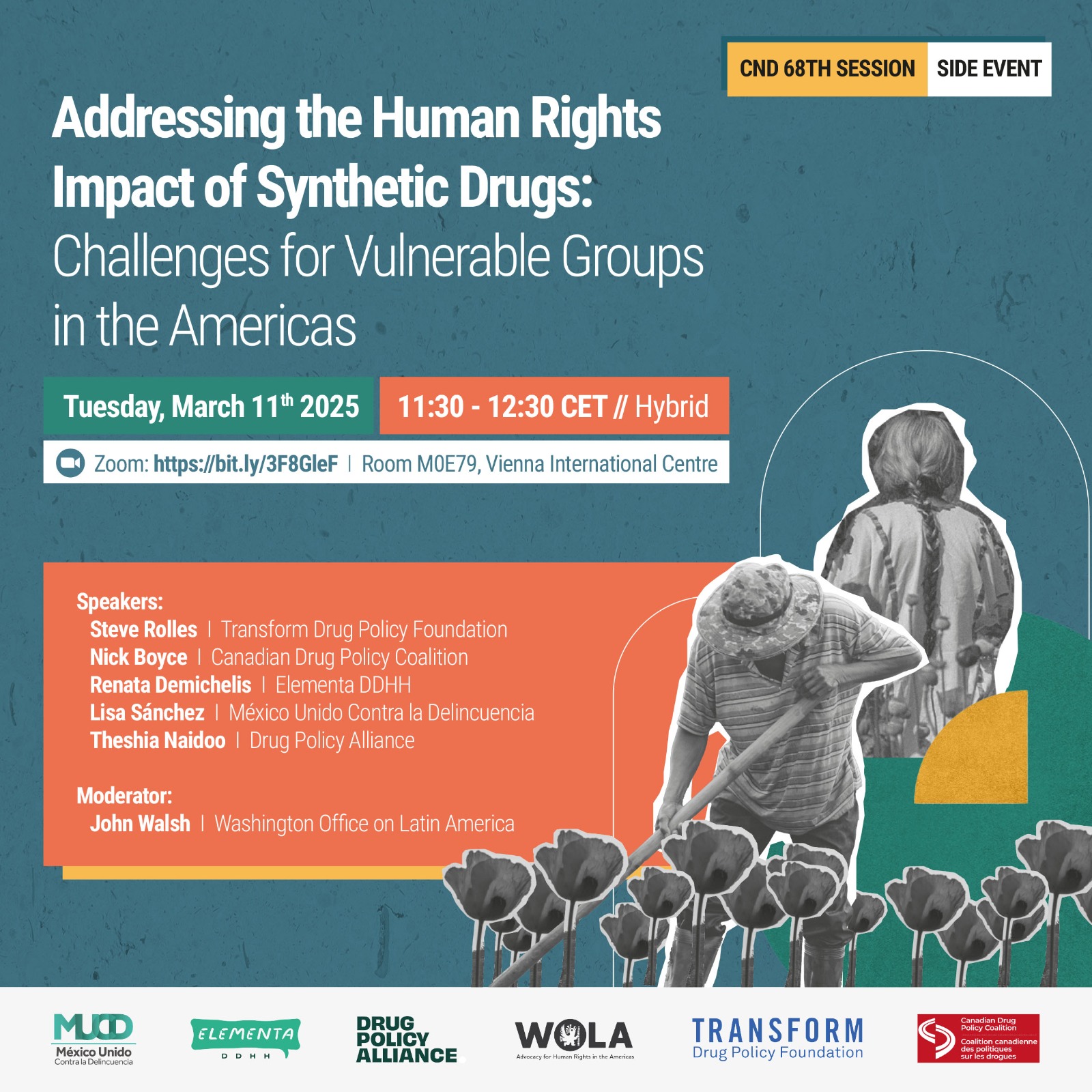
    Addressing the Human Rights Impact of Synthetic Drugs: Challenges for Vulnerable Groups in the Americas 

    Side Event organized by the Cross-Border Working Group on Synthetic Drugs 

    The Cross-Border Working Group on Synthetic Drugs is a civil society initiative convened by the Drug Policy Alliance (DPA) and the Washington Office on Latin America (WOLA) with the purpose of bringing evidence-based information and policy proposals grounded in science, health, compassion, and human rights to decision-makers in response to the synthetic drug overdose crisis, decision makers and other stakeholders champion key strategies and avoid failed and harmful paradigms. 

    Watch highlights from the session here.

    When: Tuesday, March 11th, 2025 

    Participants 

    • John Walsh, Washington Office on Latin America (moderator) 

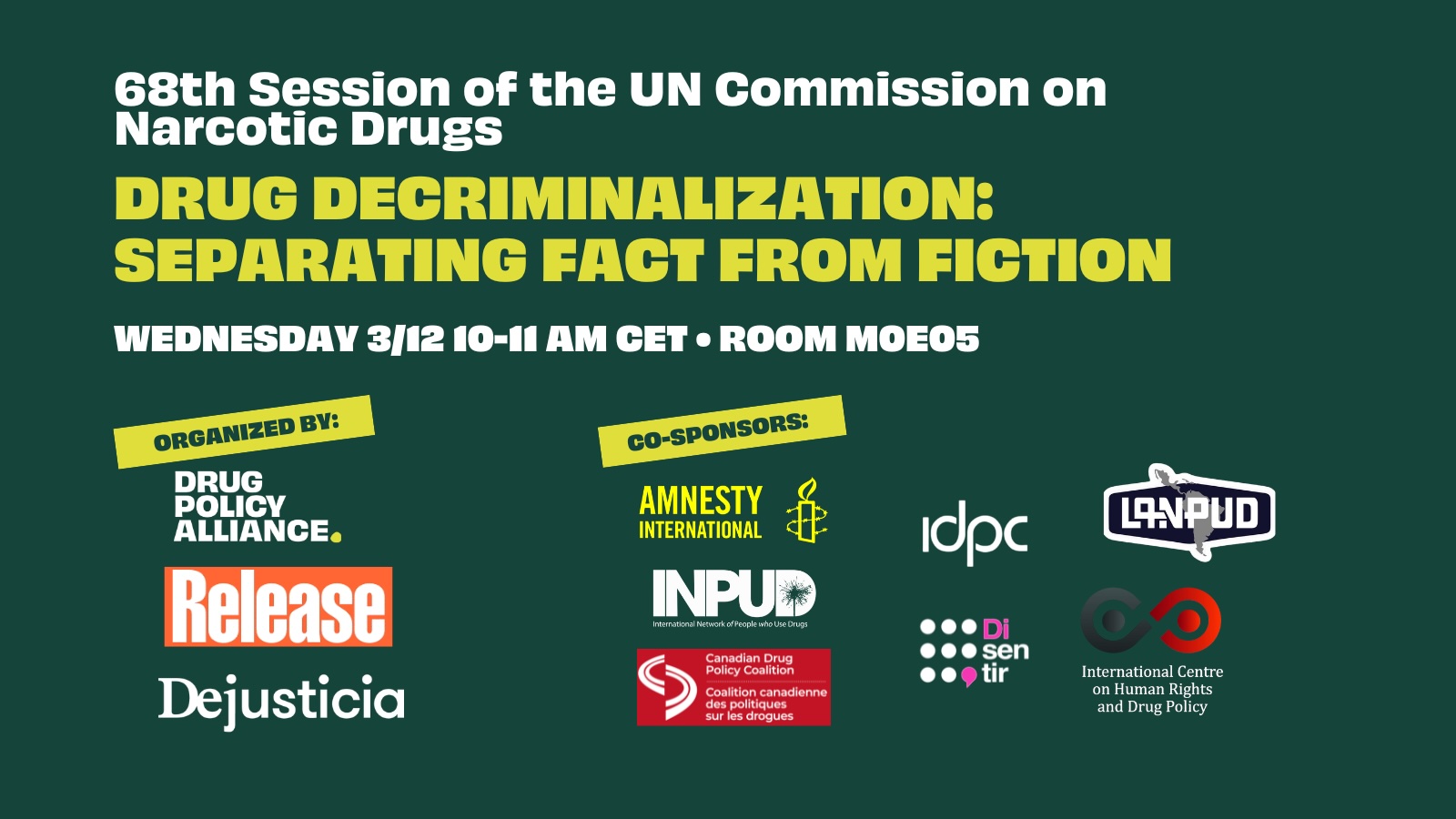
    Drug Decriminalization: Separating Fact from Fiction 

    Side Event organized by Dejusticia, Drug Policy Alliance, Release 

    The harms caused and exacerbated by drug policies that rely on criminalization and punishment are well documented.  In response, jurisdictions around the world have turned toward alternative strategies that center health and human rights, including over 70 national or subnational regions that have adopted various forms of drug decriminalization. While some of these policies have been operational for decades, other, more recent, reforms have faced backlash and setbacks. This side event will discuss the harms of criminalization, provide facts to counter misinformation about health centered drug policies, and discuss strategies employed by and lessons learned from recent decriminalization efforts. 

    Watch the session here.

    When: Wednesday, March 12th, 2025 

    Chair: Global Commission on Drug Policy  

    Speakers: 

    • Theshia Naidoo Drug Policy Alliance, U.S 
    • Nick Boyce, Canadian Drug Policy Coalition  
    • Isabel Pereira-Arana, Dejusticia, Colombia  
    • Michael Kessler, Michael Kessler Media 
    • Daniel Joloy, Amnesty International 
    • Niamh Eastwood, Release, UK 

    NGO co-sponsors: 

    • Amnesty International 
    • Canadian Drug Policy Coalition 
    • Dejusticia 
    • Disentir  
    • Drug Policy Alliance 
    • International Centre on Human Rights and Drug Policy 
    • International Drug Policy Consortium 
    • INPUD 
    • LANPUD 
    • Release  
  • A Roadmap for Canada’s Drug Policy Future: The Peter Wall International Research Roundtable

    A Roadmap for Canada’s Drug Policy Future: The Peter Wall International Research Roundtable

    The first steps for systemic change are usually the hardest. But thanks to an international community of experts, including and especially those with lived expertise on the frontlines of Canada’s drug policy crisis, we’ve surmounted that hurdle.

    Last month, over 40 researchers, frontline advocates, policymakers, and other experts convened in Vancouver for the Peter Wall Institute for Advanced Studies International Research Roundtable. The end vision of our collaboration is at once simple and dauntingly complex: to realize legal regulation of drugs in Canada to stem the tide of fatalities crippling communities across the country and end the ongoing harms of prohibition. A regulated legal supply of drugs would mean a safer supply of drugs to those who use them, elimination of the toxic drug market controlled by organized crime groups, and financial resources to invest in people who need access to health, housing, and social services.

    DONATE to Support Drug Policy Reform


    A group of people are seated at circular tables arranged throughout a room. Two people, a man and a woman, are speaking and addressing the crowd at the front of the room.
    Peter Wall International Research Roundtable (April 2019)

    We began this task by tapping into the collective expertise and wisdom of the people in the room, workshopping ideas, brainstorming solutions, and refining tactics that will bring us to our end goal. It was just a start, but critical if we are to realize the systemic change Canada needs, where principles of human rights and public health that are informed by evidence guide policy decisions—not public sentiment and the moralization of behaviour.

    We as a collective began several important initiatives during our four days together:

    • developing a strategic road map—with concrete steps—for Canada to shift away from the policies of prohibition towards those that promote public health, human rights, and social inclusion based on the legal regulation of currently illegal substances;
    • outlining areas of further research to inform this strategy and identify regulatory models for the Canadian context;
    • outlining a knowledge translation strategy aimed at building momentum for policy change; and
    • identifying opportunities for international collaborations that will support our goals.
    Six people are standing in front of a banner posing for a picture.
    From left to right: Steve Rolles, Garth Mullins, Zara Snapp, Scott Bernstein, Suzanne Fraser, Akwasi Owusu-Bempah

    Many important advocates and international experts generously offered their insight, and their involvement was critical in shaping the contours of important discussions over the four days:


    • Zoë Dodd, a passionate long-time human rights and harm reduction leader in Toronto who has for years stood on the frontlines of a grassroots lifesaving efforts
    • Steve Rolles, an expert in substances regulation from the UK who advised the Canadian government on its cannabis regulatory framework
    • Dr. Debra Meness, a skilled physician trained in both Western and traditional Ojibwe medicine from the Kitigan Zibi Anishinaabeg First Nation
    • Paul Salembier, a legal mind skilled at crafting laws and precise legal language that could save lives

    There were many, many more, and we thank them all.

    A large crowd is sitting in a theatre listening to a man on stage.
    Audience members during Peter Wall International Research Roundtable public event (April 2019)

    The Research Roundtable culminated in a public forum at SFU Woodward’s, Systems Change: Envisioning a Canada Beyond Prohibition, where activist and award-winning broadcaster Garth Mullins guided our imaginations toward a world where prohibition was a thing of the past. What would that world look like? What would it take to get us there?

    A panel of men and women sit on stage in front of a large screen displaying a promo slide of the event. To the left, a man is standing, talking to the crowd.
    Peter Wall International Research Roundtable public event (April 2019)

    The event was recorded as an episode of the Crackdown podcast and featured Akwasi Owusu-Bempah (University of Toronto); Steve Rolles (Transform Drug Policy Foundation, UK); Zara Snapp (Instituto RIA, Mexico); and Suzanne Fraser (Curtin University, Australia).

    There are mountains of evidence that the ill-conceived “war on drugs” (prohibition) has had significant negative impacts on individuals, families and communities around the world. Far from making citizens safer, prohibition and a criminal justice approach has spawned an illegal market flush with toxic drugs that kills indiscriminately (over 10,000 in Canada in the less than three years).

    Prohibition has also needlessly criminalized and ruined the lives of vulnerable people who should have never seen the inside of a jail cell. It forces individuals to turn to more dangerous methods of consumption and dissuades those who want help from accessing it. In short: it has been an abysmal failure.

    DONATE to Fund the Next Phase of our Legal Regulation Model

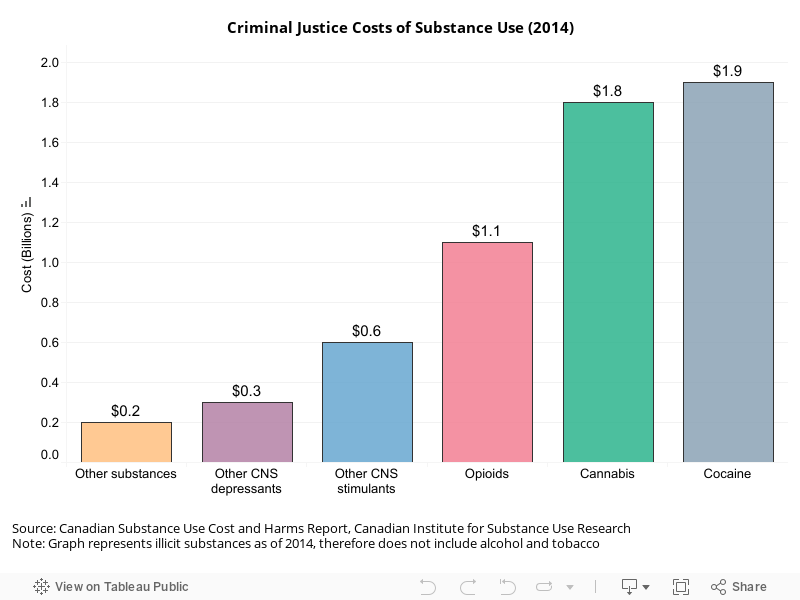
    (Interactive Graph)

    But one area of hope was a more clearly-defined path toward the future: creating regulatory models for opioids, stimulants, sedatives and psychedelics. Tapping into the collective knowledge in the room, we workshopped models of how four drugs might be available to consumers in a post-prohibition world, considering questions such as:

    • who might have access to drugs;
    • how would they access them;
    • how much can they get, and
    • where can they consume them.

    This focus group was only the first of what we anticipate will be up to 20 focus groups across Canada to gather feedback about what Canadians would imagine a legal system would look like. With the online platform we are developing, we hope to engage an additional 40,000 Canadians in these decisions over the next two years!

    Scott Bernstein, Canadian Drug Policy Coalition Director of Policy (April 2019)

    Politicians with the power to enact life-saving changes to drug policy have long argued that the lack of viable models for legal regulation were a barrier to action. This project will describe a way forward to legal regulation of all drugs and no longer will they have an excuse for inaction.

    Peter Wall International Research Roundtable breakout session (April 2019)

    Over the four days, we explored three themes in service of our mission to advance the legal regulation of all drugs in Canada: the regulation of opioids as a response to the overdose crisis; the impact of criminal justice policies on people who use drugs; and the intersections of drug policy and the social determinants of health, including poverty, housing, stigma, income, access to healthcare.

    It was from these vantage points the wealth of knowledge in the room surfaced solutions and strategies to make our shared vision a reality. The Roundtable engendered many important discussions over the four days.

    It is now time to turn words into action.

    The Peter Wall International Research Roundtable was supported by the Peter Wall Institute for Advanced Studies, Community Action Initiative, BCCDC Foundation for Public Health, and SFU Woodward’s.

  • In The Lead Up to UNGASS, Canada is Charting a New Path

    In The Lead Up to UNGASS, Canada is Charting a New Path

    It feels like we can breathe again.

    In mid-March, I attended the Commission on Narcotic Drugs (CND) in Vienna, the annual drug policy meeting where delegations from over 50 countries and numerous Non-Governmental Organizations (NGOs) come to review progress being made towards reducing the harms from drugs globally. It’s a fractious affair with the majority of the countries still wedded to a war on drugs approach. Resistance to change is in the air and god forbid anyone raises the issue that there may be better ways to address drug related issues in their countries. But the list of countries calling for reform is growing, and in the longer term we think the status quo will give way to new approaches. The next three to five years are pivotal for reforming outdated global drug policies.

    Much of the time at the meeting was focused on preparing for the upcoming UN General Assembly Special Session on Drugs (UNGASS) in New York – the most important global drug policy meeting at the UN since 1998. It provides an opportunity for countries to move in one of two different directions: either call for much needed change in the global approach to drugs or to keep their head firmly in the sand and deny that the whole UN drug control apparatus needs a thorough review. Thus far the negotiations have been tough and little progress has been made in moving countries resistant to reviewing the effectiveness of the drug treaties. Civil society organizations released a statement [link] on the first day of the meeting signed by 200 NGOs around the world calling for member states to speak out on the closed state of the negotiations.

    The document agreed upon by the end of the CND meeting is a poor reflection of the many progressive and change oriented ideas that were put into the process from UN Member States, civil society and UN agencies.

    Canada’s statement at the CND was one of the highlights of the week and literally had people in tears as the Canadian head of delegation made it clear that Canada was back as a progressive force. A huge relief for many attending.

    (photo from the conference) (Caption – Canadian civil society contingent at the CND)

    In years past, the government of Canada had been something of a pariah on the world stage, siding with countries such as Russia and blocking the addition of harm reduction in any UN wording. A year ago Canada was completely out of step with the rest of the world, (link) and lacked a clear vision on how to handle the so-called world drug problem.

    This time things were different.

    Before the conference, we worked with our National UNGASS Working Group to create a ten-point policy brief that we have given to federal government officials to consider for the meeting in New York next month. To our delight, the statement made by our government at the CND reaffirmed Canada’s commitment to harm reduction, legalization of cannabis, support for better access to essential medicines, a public health approach, new metrics with which to measure the success of drug strategies and the end of the death penalty for drug related offenses, many of the points we outlined in our policy brief.

    The timing of this statement proves that we have a government that is not only listening, but also beginning to act.

    Then two weeks ago, a number of civil society organizations met with Canada’s Minister of Health, Jane Philpott in Ottawa and presented her with a wide range of issues that need addressing. The meeting was a good beginning and we look forward to working with Minister Philpott as Canada considers developing a new national drug strategy that could, if the will is there, lead the world in applying evidence to the development of a national approach to drugs.

    We also received a letter from the Minister inviting CDPC to be a part of the official delegation to the UNGASS meeting along with two other civil society representatives, Canadian Students for Sensible Drug Policy (CSSDP) and the Thunderbird Partnership Foundation. The Canadian Centre on Substance Abuse and the Canadian Association of Chiefs of Police are the other two organizations on the delegation.

    We are delighted that our call to further engage civil society organizations in the international delegation was taken up by the Minister and look forward to working with our delegation partners at the upcoming UNGASS meeting.

    Last month we had more good news – Health Canada finally de-scheduled naloxone, making it easily available as a non-prescription drug (link). They also announced a four-year extension to the exemption for Insite to remain open, and recently Toronto Public Health announced that it will be applying for federal permits to open 3 supervised injection sites in the near future!

    I’ve been away for a couple of weeks and it feels like I’ve returned to a whole different Canada.

    These next weeks are going to be crucial for Canada’s drug policy. We still need to advocate for stronger legislation around responses to overdoses that have reached pandemic levels in our community. Please read our op-ed written with coalition member, Pivot Legal Society by clicking here on what the government can do right now to end this ongoing tragedy. Most overdoses are preventable with awareness and a quick response. (link)

    So much has changed in what feels like so little time, but we must remember that true reform won’t happen until the war on drugs is over. This is just the beginning.

    Thank you for all your support. We’ll be keeping you updated on the UNGASS activities in the days ahead.

  • The Political Parties Response to our Drug Policy Questionnaire

    The Political Parties Response to our Drug Policy Questionnaire

    Last month, we worked with the Canadian HIV/AIDS Legal Network, and “moms united and mandated to saving the lives of Drug Users” (mumsDU) to send out a policy questionnaire to all the political parties to get their opinion on issues surrounding an ever-changing drug policy landscape. Our intention was to gauge the direction each party would take Canada if elected on October 19th.

    Fortunately, with the notable exception of the Conservative Party which didn’t respond, the responses we received are very encouraging. All parties gave us answers that indicated a different approach to drug policy would be taken after the votes have been counted, but there are subtle differences between the parties on each of the issues. Below is a summary of answers the parties gave us.

     Does your party support restoring harm reduction as a key pillar in Canada’s federal drug strategy, including support for supervised consumption services as one important component of an overall federal strategy on drugs — and as part of efforts to prevent the spread of HIV and hepatitis C (HCV), associated with unsafe injection drug use?

    All responding parties agreed that harm reduction needs to return as a key pillar in Canada’s national drug strategy, including support for safe-consumption services. The NDP mentioned that harm reduction was a “fundamental pillar in framing Canada’s drug policy”. The Liberal Party recognized the importance of harm reduction policies and would prioritize “evidence based policies”. Both the NDP and the Green Party voiced their opposition to Bill C-2, legislation that makes it difficult to open supervised-consumption sites, and promised to address the bill after the election.

    Does your party support Good Samaritan legislation as one important component of a comprehensive approach to addressing the pandemic of death by drug overdose in Canada, and expediting access to naloxone by making it a non-prescription drug?

    We found it encouraging that not only did the Liberal Party agree that Good Samaritan legislation should be enacted, but they correctly cited the United States as a leader in this regard. The Green Party answered both of our concerns in the questionnaire by supporting passing Good Samaritan legislation and easier access to naloxone. In fact, the Greens were the only party that explicitly mentioned that they would allow naloxone to be offered over the counter. Neither the Liberal Party nor NDP mentioned rescheduling naloxone, but instead both mentioned that they would be interested in working with experts and civil society groups such as the CDPC on creating better legislation and good policy on this issue if they were to form government.

    Does your party support considering new approaches to regulating and controlling cannabis production, distribution and possession, as a way of minimizing the harms of the cannabis industry and cannabis use, promote public health, and respect the human rights of adults who use it?

    Ever since Liberal Leader Justin Trudeau admitted to smoking cannabis after being elected to public office, which was followed by promising to legalize and regulate cannabis if elected, drug policy has become an active topic in electoral politics. The NDP mentioned that “no one should go to jail” over possession of small amounts of cannabis, a position they’ve held for over 40 years, since the release of the LeDain commission. The Greens have a position similar to that of the Liberals, full legalization, and mentioned that it’s time for Canada to have “an adult conversation on ending the war on drugs”.

    Given the scientific evidence of the ineffectiveness of mandatory minimum sentences for non-violent drug offences, does your party support eliminating the use of such sentences and again allowing judges to employ discretionary practices for these offences?

    Mandatory minimum sentencing is one of the signature pieces of legislation that the Conservative government has put out since winning their majority in 2011.  Both the NDP and Green Party directly mention their opposition to the Conservatives’ Bill C-10, which puts in place mandatory minimums for non-violent drug offences. The Green Party states clearly that it would repeal Bill-10, while the NDP and Liberals say they would consider policies that reduce crime, prevent re-offending, support rehabilitation of offenders and victim’s rights. The Liberal Party does not outright say what their stances on mandatory minimums are for non-violent drug offences in the questionnaire. Instead, they state that mandatory minimums do not deter crime, but that they do have a place “when necessary to protect the public from specific threats.”

    Does your party support Canada advocating at the 2016 UN General Assembly Special Session on Drugs (UNGASS)  for a comprehensive approach to drugs based on evidence, public health objectives, and human rights standards, including support for harm reduction programs?

    Does your party support the creation of a mechanism within the United Nations that brings countries and civil society experts together to consider alternatives to drug prohibition as the main strategy for controlling drugs?

    All political parties that responded agree that Canada needs to take a progressive role at next years United Nations General Assembly Special Session on Drugs (UNGASS). The NDP simply answered “yes” to our questions, and the Green Party said that “Canada should be a leader at the 2016 UNGASS to promote progressive and science-based drug policies that accomplish pressing public health objectives”. The answer from the Liberal Party was clearly the most fleshed out, and well researched. They agreed that civil society groups need to play a strong role both nationally and internationally “in order to find real solutions that are based on evidence.”

    Overall these responses are quite encouraging and indicate that if any of these parties were elected on October 19th, we would see a significant change in direction towards a public health approach to drugs in Canada.

    Check out the full party responses here:

    Liberal Party of Canada Response

    New Democratic Party Response

    Green Party of Canada Response

  • Why Canada is no longer a leader in global drug policy

    Why Canada is no longer a leader in global drug policy

    Co-authored with Jenna Valleriani, director of Canadian Students for Sensible Drug Policy.

    This op-ed first appeared in the Globe and Mail, Feb. 27, 2015

    Prime Minister Stephen Harper’s statement about the failures of our existing drug policy is mostly on point. It’s just the last bit he gets wrong: “I think what everyone believes and agrees with, and to be frank myself, is that the current approach is not working, but it is not clear what we should do.”

    He’s wrong, because we know what we should do: Supervised injection sites; prescription heroin; medical cannabis dispensaries; crack pipe distribution; drug testing kits; Naloxone for reversing opioid overdose.

    We know these innovative health services reduce the harms of drugs and save lives, and we all agree “the current approach is not working.” And yet, access to these important innovations is unequal across Canada because of a lack of leadership at the federal level, and a failure to collaborate across all jurisdictions – local, provincial, national and international.

    We don’t need to look far to start. Vancouver is known internationally for its innovation in drug policy reform – it houses North America’s first supervised injection site and prescription heroin program, and has recently seen a proliferation of medical cannabis dispensaries. The city’s drug policy is based on an evidence-based four pillar approach: harm reduction, prevention, treatment and enforcement. This approach has been adopted around the world, but also here in Canada, officially forming the basis for the Toronto’s drug strategy.

    Unfortunately, the federal government is out of step with international dialogue and doesn’t believe in the four pillars – it dropped harm reduction in 2007 when it changed the National Drug Strategy to the National Anti-Drug Strategy. While countries like Portugal have moved towards decriminalization and a more health-focussed approach, Canada has instead pursued a more punitive, conventional “war on drugs” approach – epitomized by the introduction of mandatory minimum sentencing for low level drug offenses. Recently Health Canada spent $7-million of our precious tax dollars on a fear-based anti-cannabis ad blitz that the country’s top physician groups suggested was politically motivated.

    The lack of vision at the top means that in a country known internationally for its innovation in harm reduction, many of our best public health interventions only exist in isolated local cases. This is not entirely unexpected. The story of drug policy reform is often one of grassroots change lead by users, local authorities, politicians, drug policy experts, service workers, and organizations. In Europe, for example, cannabis social clubs are driving much of the pressure for cannabis reform. Harm reduction services in countries like Germany, Switzerland, and the Netherlands started as trials in innovative cities before being scaled up nationally.

    In Canada, this bottom-up drive for change is exemplified by the current explosion of medical cannabis dispensaries in Vancouver. Dispensaries have always operated outside the federal access program, in a type of quasi-legal status, or as an act of ‘civil disobedience.’ But the city’s recent explosion of these storefronts has underscored the disconnect between local and national. Although the federal government projects a $1-billion free market medical cannabis industry in the future, currently it’s a notoriously slow, selective, bureaucratic process with little approvals and many rejections.

    The result is a void that “unofficial” dispensaries have been happy to fill. One Vancouver city councillor recently pegged the number of dispensaries at 61. Because of shifting of cultural norms around the acceptance of cannabis – polling shows that Canadian attitudes on cannabis are well ahead of the laws – the city and the police aren’t entirely sure what to do. But they are on record saying they will not bother dispensaries that follow best practice dispensing.

    This is fine for Vancouver, but we need a comprehensive national drug policy, so that essential healthcare innovations like medical cannabis – and prescription heroin, harm reduction kits, and product testing – are available consistently, throughout the country.

    Instead, Canada heads backwards, no longer an international drug policy leader, and our reputation on the international stage suffers for it. Innovation at the municipal level is essential, but it needs to be backed by federal support. Canada needs to stop criminalizing people and instead address the health needs of Canadians. The current approach is not working.

  • A gift to the drug kingpins: and the need for a North American Drug Policy Agreement

    A gift to the drug kingpins: and the need for a North American Drug Policy Agreement

    This article first appeared as an op-ed in the National Post, April 21, 2014

    We know the stories. Hockey bags that go south full of B.C. bud and return full of Latin American cocaine. Elaborate underground tunnels at both the U.S.-Mexico and U.S.-Canada borders. Canadian mobsters being gunned down in Mexican resort towns. Unlikely Mennonite drug mules crossing North America’s borders with illicit packages concealed in gas tanks and old farm equipment.

    It’s easy to think it’s always been this way, but the reality is we can thank the North American Free Trade Agreement (NAFTA) for much of this activity. So this year, while business leaders and politicians fete the 20th anniversary of NAFTA, drug runners and cartels will be doing the same.

    It shouldn’t come as a surprise. Free traders wax poetically about the interconnected, globalized economy, and the whole point of NAFTA was to strengthen the economic integration of Canada, the U.S. and Mexico by reducing trade barriers.

    How’s this for economic integration, then? Access to legal, regulated medical marijuana in Canada and the U.S. has reduced black market demand across the continent. This phenomenon will become more pronounced with the recent legalization of recreational marijuana in Colorado and Washington, and more states to come. It’s worth noting too that concerns over drug gangs generally, but Canadian gangs in particular, were a key reason Washington voters supported legalization in that state. Regardless, marijuana farmers in Mexico have responded to decreased black market demand by shifting to poppy cultivation. This has resulted in a surge of cheap heroin availability at a time when heroin use is increasing in both the U.S. and Canada.

    Yet despite the predictability of this kind of domino effect in a continental economy, then-U.S. president Bill Clinton forbade U.S. negotiators from discussing the illegal drug trade in NAFTA talks. Years later, U.S. Drug Enforcement Administration official Phil Jordan revealed: “We were prohibited from discussing the effects of NAFTA as it related to narcotics trafficking, yes.” As a result, “For the godfathers of the drug trade in Colombia and Mexico, this was a deal made in narco heaven.”

    Indeed. NAFTA brought a proliferation of maquiladoras — companies operating in duty-free free-trade zones— to the north of Mexico and a massive increase in cross-border commercial traffic. In other words, freer movement of goods in a continent that represents “the world’s largest illicit drug market” according to the UN Office on Drugs and Crime. NAFTA also brought an influx of cheap, subsidized U.S. crops — including corn, soybeans, wheat, cotton and rice — resulting in the collapse of northern Mexico’s agricultural sector. Some farmers shifted to marijuana, which is 1,000 times more lucrative than corn, pound for pound. The rest were in need of work.

    Basically, NAFTA helped create ideal conditions for the rise of a lucrative cross-border drug and gun trade.

    Governments responded by escalating the war on drugs, with devastating impacts on citizens and their communities throughout North America. An estimated 100,000 Mexicans have died or disappeared in drug-related violence, and the U.S. has the highest prison population in the world with over 2 million citizens behind bars. Of these, roughly 500,000 Americans are incarcerated on any given night for a drug law violation. At the same time, death from overdose and HIV/AIDS among injection drug users has taken thousands of lives in the U.S. and Canada. Add to all of that the pain of the families of those directly affected and the communities that have suffered these losses.

    Twenty years after NAFTA’s signing, it’s time to finally acknowledge the drug market is a part of our integrated economy. In turn, we need to negotiate a modern, 21st century drug policy that addresses the health and safety issues across the region and undermines the illegal profiteers.

    The good news is, there’s cause for optimism. The Organization of American States in particular is providing refreshing leadership through member states like Mexico, Colombia and Guatemala calling for a discussion about alternative approaches to the enforcement-heavy war on drugs. And some jurisdictions are implementing bold new paradigms on their own. Similar to the moves in Colorado and Washington, Uruguay became the first country in the world to authorize a legal, regulated market for adult cannabis use.

    The current overemphasis on criminal justice approaches to drug control in North America has sidelined a variety of programs that can minimize the harms related to the drug trade and substance use, including public health promotion and prevention programs. It has also curbed economic and social advancement for drug-producing countries.

    A North American Drug Policy Agreement could serve as a powerful statement of shared responsibility in addressing the trans-national drug problem. Such an agreement should include provisions for the consuming countries (U.S. and Canada) to reduce demand through social development and improved access to health responses. But it should also map out a legal, regulatory control framework for drugs that are currently illicit. This would reduce the violence within the drug trade, and all of the other prohibition-related harms that are far more destructive to communities and countries than substance use itself.

    Yes, it would mark a departure from 40 years of restrictive, prohibitionist policies, but as Stephen Harper himself has noted, “the current approach is not working.” It’s time to try something else.

  • The Road to 2016 – Drug Policy Consensus Shattered

    The Road to 2016 – Drug Policy Consensus Shattered

    There’s a Crack in Everything – That’s How the Light Gets In (with thanks to Leonard Cohen)

    I couldn’t help it. Sometimes my mind would wander while attending the Commission on Narcotic Drugs (CND) meeting in Vienna – the annual drug policy palooza where UN member states gather to shore up the failed prohibitionist policies of the past. Even an unanticipated Russell Brand appearance could do only so much to enliven the sessions.

    In those mind-wandering moments, I found myself humming Leonard Cohen’s famous song “Anthem,” especially the beautiful line: “There’s a crack in everything, that’s how the light gets in.”

    I suppose my mind wasn’t so much wandering, as it was synthesizing the stark disconnect between the evidence presented at the outset of the meeting – in fact, the science at the heart of the enterprise – and the actual decisions arrived at by CND delegates.

    There is unquestionably a crack in the consensus in these global discussions, a crack that may well end up being a chasm as wide as the Grand Canyon by the time the UN Special Session on Drugs (UNGASS) takes place in 2016 in New York.

    Decriminalization

    As for the light, that came in part from the two stellar UN-appointed scientific panels that reported out at the beginning of the meeting. Michel Kazatchkine, UN Envoy to Eastern Europe and Asia on HIV, and Nora Volkow, Director of the US National Institute on Drug Abuse, chaired panels that delivered strong statements on the need for problematic drug use to be dealt with as a public health issue not a criminal issue. Kazatchkine’s group noted: “Criminalization of drug use, restrictive drug policies and aggressive law enforcement practices are key drivers of HIV and Hepatitis C epidemics.” Volkow’s group added: “We consider that criminal sanctions are not beneficial in addressing substance use disorders and discourage their use.”

    The divide between the above statements and the content of the negotiations at the CND was vast – the overwhelming majority of delegates clung to the status quo and refused to even consider language on decriminalization. Clearly we’ve made very little progress since Portugal (2001) and the Czech Republic (2009) decriminalized all drugs for personal use, on their own without fanfare or bringing it up at the CND.

    Harm Reduction

    In a somewhat Orwellian turn of language control, a number of countries including Canada demanded the words ‘harm’ and ‘reduction’ not appear side by side, but they could endorse “measures aimed at minimizing the negative public health and social impacts of drug abuse that are outlined in the WHO, UNODC, UNAIDS Technical Guide.”

    Harm reduction, in other words.

    These programs are the most cost effective way to engage people who use drugs and often the only bridge to more mainstream public health services. The scientific panel offered clear statements on the benefits and cost-effectiveness: “Harm reduction interventions are good value for money, with average costs per HIV infection averted ranging from $100 to $1,000.”

    Apparently scientists can use the words, but not the members of the CND.

    Death Penalty

    Switzerland, with support from others, pushed hard at the meeting for the Joint Ministerial Statement to clearly state the death penalty was not an appropriate response to drug offenses of any kind. In the end they failed, being blocked by countries like Iran, China and a number of other Middle Eastern and Asian countries. Canada’s silence on this discussion was deafening.

    The Swiss allowed the “consensus” document to go forward but not without delivering the following statement at the end of the meeting:

    “The death penalty is in opposition to our position with regard to all offences. The International Covenant on Civil and Political Rights says that it should only be applied for very serious crimes and therefore very rarely. The human rights committee says we should very much limit the use of the death penalty. The International Narcotics Control Board (INCB) said that its application was never in the spirit of the (drug) conventions. The INCB encourages countries to consider its abolition. In this background, the silence of the Joint Ministerial Statement (JMS) on the death penalty is regrettable. It does not take into account our position and that of other (UN) bodies. We will continue to promote the abolition of the death penalty. We ask that our agreement with the JMS is on this understanding – capital punishment is not in line with our commitment to combat the world drug problem. International cooperation on drug law enforcement is contingent to respect for all human rights – as well as the right to life.”

    2016 UN General Assembly Special Session on Drugs (UNGASS)

    If there’s one thing that we learned while attending the CND it’s that any meaningful consensus on new approaches to addressing drug problems globally will be near impossible to attain when the biggest international drug policy meeting in 20 years – UNGASS 2016 – takes place in two years at the UN General Assembly in New York.

    This meeting was called in response to the pleas from the presidents of Mexico, Colombia and Guatemala a little over a year ago, calling on the UN to facilitate real dialogue on alternative approaches to the global drug problems.

    UNGASS is huge because it will undoubtedly precipitate a new approach to drug policy – either through the development of a more progressive global consensus, or, more likely, because it will shatter the distorted idea that a global consensus is possible.

    Either way, countries should be free to chart their own appropriate path forward to address drug problems, grounded in the public health and human rights imperatives enshrined in various UN conventions, without the shackles of the misguided and restrictive drug control treaties.

    “Ring the bells that still can ring
    Forget your perfect offering
    There is a crack in everything
    That’s how the light gets in.”
    – Leonard Cohen, Anthem

  • Measuring lives saved: the facts about safer consumption services

    Measuring lives saved: the facts about safer consumption services

    This post first appeared in the Centre for Addictions Research of BC’s blog Matters of Substance.

    Despite the pragmatic nature of harm reduction programs, and their demonstrated ability to save lives, controversy still dogs efforts to scale-up harm reduction. One of the most misunderstood and controversial initiatives are safer consumption services (SCS).

    In the last 20 years, SCS services (sometimes also known as safer injection services (SIS) have been integrated into drug treatment and harm reduction programs in Western Europe, Australia, and Canada. The focus of these services is facilitating people to safely consume pre-obtained drugs with sterile equipment. These services can be offered using a number of models including under the supervision of health professionals or as autonomous services operated by groups of people who use drugs.

    The objectives of SCS include preventing the transmission of blood-borne infections such as HIV and hepatitis C; improving access to health care services for the most marginalized groups of people who use drugs; improving basic health and well-being; contributing to the safety and quality of communities; and reducing the impact of open drug scenes on communities.

    Safer consumption services grew out of the recognition that low-threshold, easily accessible programs to reduce the incidence of blood-borne pathogens were effective and cost-effective. This was the conclusion of over 30 research studies on Vancouver’s own supervised injection site known as Insite.

    Research has found that SIS services:

    • are actively used by people who inject drugs including people at higher risk of harm;
    • reduce overdose deaths — no deaths have occurred at Insite since its inception;
    • reduce behaviours such as the use of shared needles which can lead to HIV and Hep C infection;
    • reduce other unsafe injection practices and encourage the use of sterile swabs, water and safe needle disposal. Users of these services are more likely to report changes to their injecting practices such as less rushed injecting;
    • increase the use of detox and other treatment services. For example, the opening of Insite in Vancouver was associated with a 30% increase in the use of detoxification services and in Sydney, Australia, more than 9500 referrals to health and social services have been made since the service opened, half of which were for addiction treatment;
    • are cost-effective. Insite prevents 35 new cases of HIV and 3 deaths a year providing a societal benefit of approximately $6 million per year. Research estimates that in Sydney, Australia, only 0.8 of a life per year would need to be saved for the service to be cost-neutral;
    • reduce public drug use; and reduce the amount of publically discarded injection equipment; and
    • do not cause an increase in crime.

    Professional groups such as the Canadian Medical Association, the Canadian Nurses Association, the Public Health Physicians of Canada, the Registered Nurses Association of Ontario, and the Urban Public Health Network have expressed their support for SCS.

    Clearly it’s time to move beyond controversy and get on with creating more of these life-saving programs.