
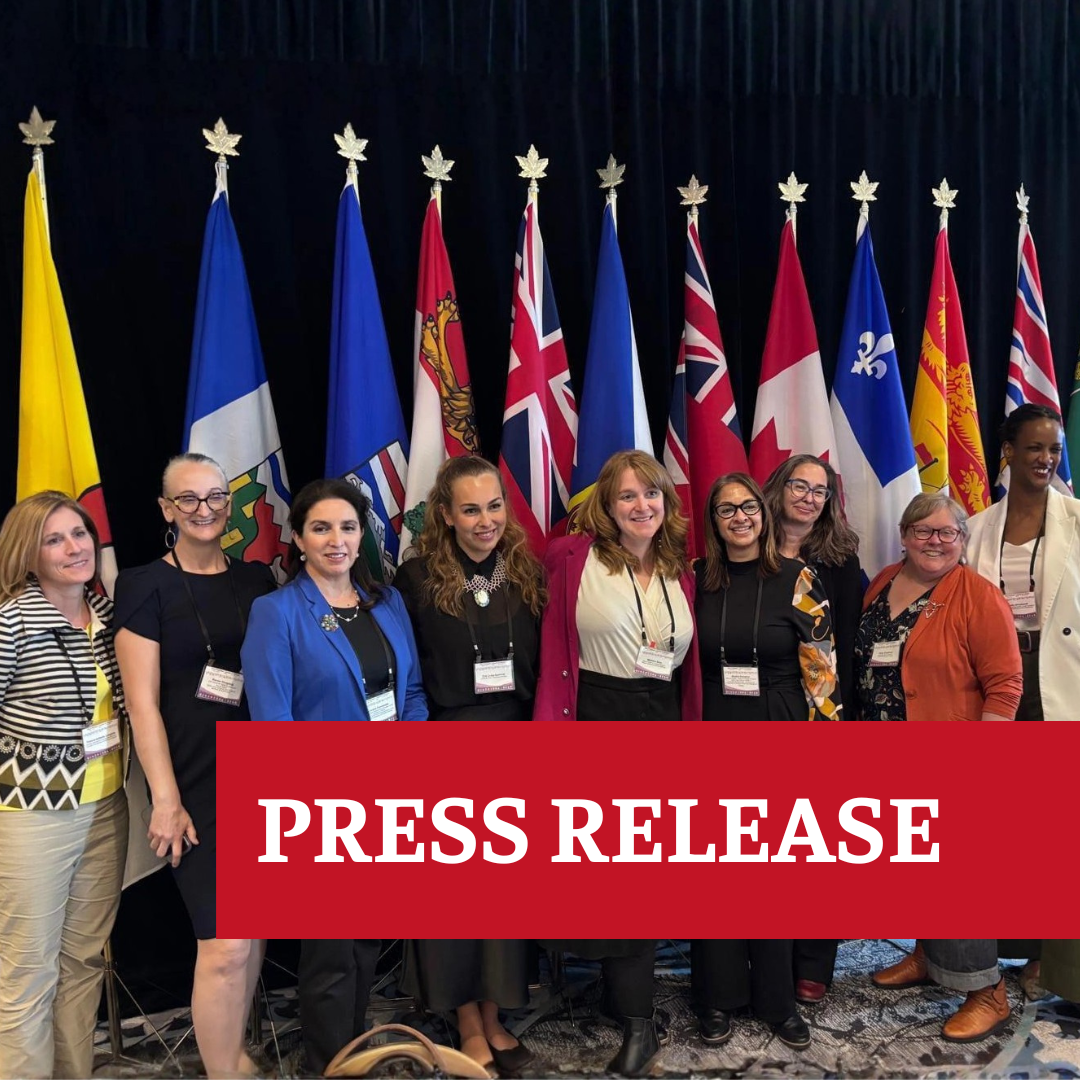
FOR IMMEDIATE RELEASE
Joint statement demands accountability, federal infrastructure, and binding commitments to make human rights real for everyone in Canada.
Regina (May 21, 2026) — As federal, provincial, and territorial representatives gather at the Forum of Ministers on Human Rights this week, the newly-formed Civil Society Forum for Human Rights in Canada is calling on governments to take immediate and concrete action on human rights implementation.
The Civil Society Forum delivered their statement to the Honourable Minister Marc Miller, responsible for human rights implementation at the federal level, the Honourable Minister Rebecca Alty, and the Honourable Rob Oliphant, along with Attorneys Generals from several provinces and territories — stressing the statement’s importance as a guidepost for human rights implementation at all levels of government.
“The timing of this Ministers’ Forum is critical. People across Canada are facing violence, discrimination, homelessness, environmental harm, and persistent inequality,” says Zoë Craig-Sparrow, Vice-President of Justice for Girls. “Canada participates in international review processes and receives recommendations, but domestically there is no implementation framework and no clear accountability mechanism. For Indigenous, racialized, migrant, low-income, women and gender-diverse persons, and disabled communities, these failures have life-and-death consequences.”
“Human rights cannot remain as simply words on paper. We need to close the gap between promises and action,” says Michèle Biss, Executive Director at the National Right to Housing Network. “When human rights go unimplemented, it shapes everything — people are excluded from decisions that affect them, and governments use narrow interpretations of their obligations in court to avoid accountability under the Charter. Governments at every level must step up to protect and save lives.”
Six Demands for Immediate Action
The Civil Society Forum is calling on governments to act on six priorities:
- Transparent and accountable Ministers’ Forum — Establish a public mandate, clear decision-making processes, and a follow-up mechanism to track implementation commitments.
- A legislated national human rights implementation framework — Develop a legal framework, with civil society input, to translate Canada’s domestic and international human rights obligations into lived reality no later than December 2027.
- A federal Department of Human Rights — Create a dedicated central body, working in coordination with the Departments of Intergovernmental Affairs and Justice, to champion human rights implementation and ensure cohesion across all levels of government.
- Economic, social, and cultural rights as binding legal obligations — Affirm these rights are justiciable and align legislation, budgeting, and policy accordingly — including ratification of the American Convention on Human Rights and the Optional Protocol of the International Covenant on Economic, Social and Cultural Rights, ahead of Canada’s UN review in early 2027.
- A formal role for municipalities — Formalize local governments’ participation in human rights forums and implementation processes, given their frontline role in delivering programs that engage these rights.
- Stable, ongoing funding for civil society engagement — Establish a civil society engagement fund, with contributions from each Forum member, to support treaty reporting, monitoring, and implementation work.
“As governments around the world openly challenge human rights, Canada has both the opportunity and the responsibility to demonstrate a different and more productive path forward, both in its interactions with other nations and through meaningful implementation at home,” says DJ Larkin, Executive Director of the Canadian Drug Policy Coalition.
“We are united in our shared belief that all human rights are indivisible, interdependent, and interrelated,” says Meghan Doherty, Director of Global Policy and Advocacy at Action Canada for Sexual Health and Rights. “And that systemic changes to Canada’s human rights infrastructure are necessary for the realization of any and all of our human rights.”
-30-
Media Contact:
Jessica Tan
Communications Lead
National Right to Housing Network
[email protected]
613-621-4575
About the Civil Society Forum for Human Rights in Canada
The Civil Society Forum for Human Rights in Canada is a group of civil society organizations, advocates, and academics united around a shared vision: a Canada where human rights are not merely aspirational, but legally binding, fully funded, and felt in the daily lives of every person in this country.
Signatories
- Action Canada for Sexual Health and Rights
- Alex Neve, Professor of International Human Rights Law, University of Ottawa
- Amnesty International Canadian Section (English-speaking)
- Atlantic Human Rights Centre, St Thomas University
- Canadian Centre for Housing Rights
- Canadian Coalition for the Rights of Children
- Canadian Drug Policy Coalition/Coalition canadienne des politiques sur les drogues
- Canadian Feminist Alliance for International Action
- Charter Committee on Poverty Issues
- Colour of Poverty – Colour of Change
- Human Rights Research and Education Centre, University of Ottawa
- John Humphrey Centre for Peace and Human Rights
- Justice for Girls
- Maytree
- Mining Watch Canada
- National Right to Housing Network
- Righting Relations Canada
- Sandra Wisner, Director, International Human Rights Program, The Henry N.R. Jackman
- Faculty of Law, University of Toronto
- Social Rights Advocacy Centre
- South Asian Legal Clinic of Ontario
- The Canadian Association of Elizabeth Fry Societies
- The Helix Foundation for Children and Youth
Backgrounder:
Despite being a signatory to numerous international human rights treaties, Canada has no formal infrastructure to implement recommendations from United Nations human rights bodies. This means that when the UN identifies gaps in Canada’s human rights record — on housing, health care, Indigenous rights, and more — there is no legal obligation, dedicated institution, or funded mechanism to act on them. The result is a persistent gap between the rights Canada promises and the reality people experience.