Author: Canadian Drug Policy Coalition

  • National Day of Action on the Overdose Crisis 2019

    National Day of Action on the Overdose Crisis 2019

    Three years after a public health emergency was called in British Columbia, the need and urgency to end the drug war is more pressing than it has ever been. The Public Health Agency of Canada recently released a grim statistic: more than ten thousand people in Canada have died from fatal overdose in under three years.

    Members of Moms Stop the Harm are all too familiar with the pain of loss. They came to the National Day of Action on the Overdose Crisis to remember their loved ones and fight for policy reform. At the heart of this crisis is a simple answer that remains painfully out of reach: a safe supply of drugs.

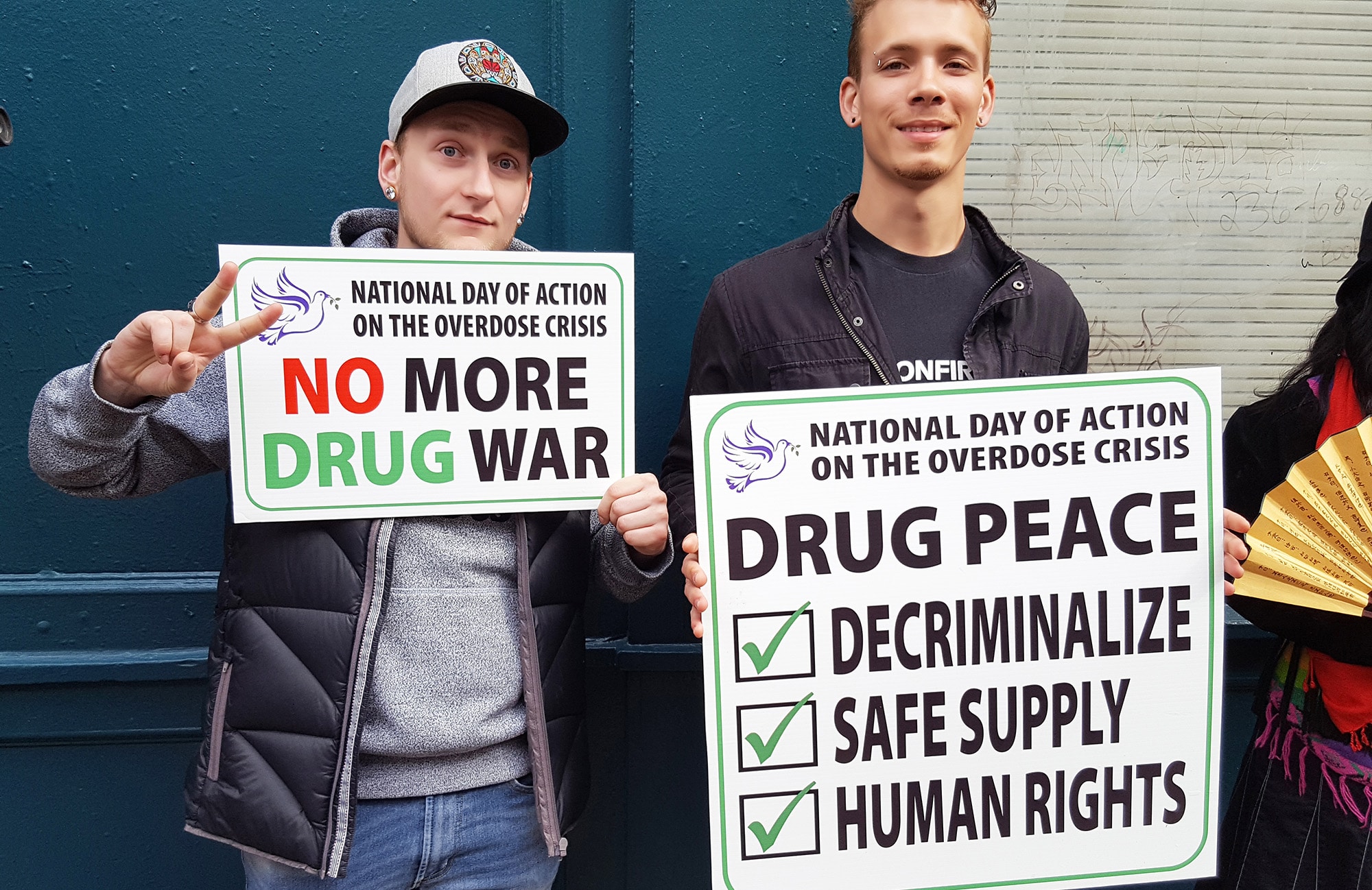
    Hundreds of people gathered at 10:30 a.m. outside of Insite, North America’s first sanctioned supervised injection site, for the National Day of Action. A band welcomed the crowd as people brought floats and carried signs.

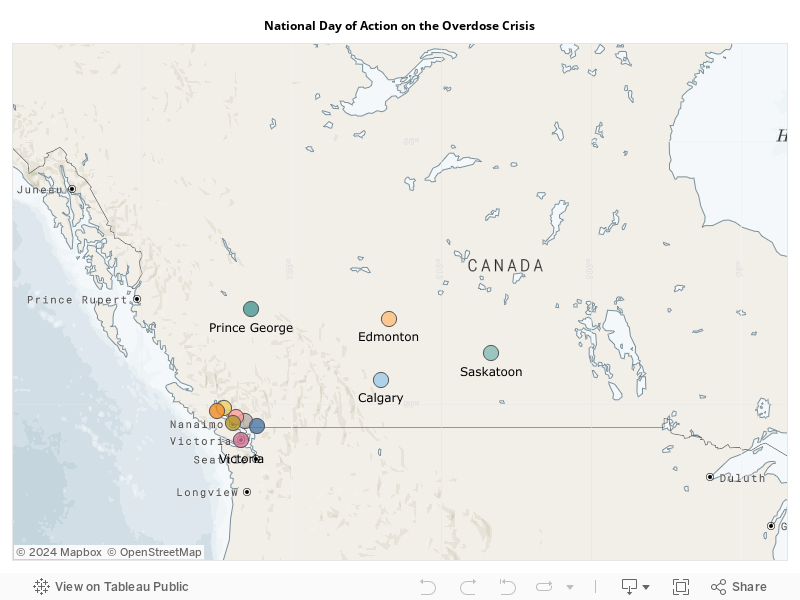
    The tragedy touches all corners of society and attracted people from across the province. Similar events were happening in other provinces as well.

    (Interactive Map)

    The day was a national call for action. In 2017 alone, 4034 people died from fatal overdose across Canada.

    The drug war has been a catastrophic failure. Prohibition and criminalization have handed the global supply of drugs into the hands of highly organized, transnational criminal organizations where an insatiable drive for profit blinds them from the human toll. Drugs, now laced with fentanyl and its analogues, are ravaging communities with little regard for the safety of consumers.

    Canadian Drug Policy Coalition executive director Donald MacPherson addressed the media, echoing concerns around Canada’s fatal drug policies, which have created the current crisis, underscoring the need for a safe drug supply. The logic supporting this is so simple and strong, yet stigma born out of years of criminalization has shut down progress on this potentially powerful means to saving lives.

    After initial speeches outside of Insite by organizers and an opening performance by Culture Saves Lives, the massive crowd marched up Hastings Street, flanked by police and followed by media.

    They ended up at the steps of the Vancouver Art Gallery where members of the community and their supporters spoke about the devastating toll of overdose deaths and unrelenting courage of people affected by the structural violence of prohibition.

    “We’re out there saving lives every day. We got a lot of power as people in the Downtown Eastside.”

    Malcolm (Western Aboriginal Harm Reduction Society)

    Despite the pain and grief etched on so many faces, there were strands of hope that connected people during the rally. Frontline workers, peers, and people who use drugs who have shouldered this crisis and life-saving responses including overdose prevention sites, supervised consumption services, naloxone distribution, and simply being there for people when needed, renewed a commitment to fight for their right to safety, security, and dignity.

    The fight continues; and so will we.

  • Canadian Drug Policy Coalition and Pivot Legal Society successfully defend supervised consumption at Federal Court of Canada

    Canadian Drug Policy Coalition and Pivot Legal Society successfully defend supervised consumption at Federal Court of Canada

    The precedent-setting decision protects public health and harm reduction efforts from unnecessary barriers and interference from third parties

    Vancouver, BC – This week, the Honourable Justice Mosley released his decision on a judicial review application brought forward by Edmonton’s Chinatown and Area Business Association (CABA). CABA challenged the approval of three desperately-needed supervised consumption sites in downtown Edmonton, asserting that it was not adequately consulted in Health Canada’s decision to approve the services.

    In December 2018, the Canadian Drug Policy Coalition (CDPC), represented by Pivot Legal Society’s Caitlin Shane and Ethos Law Group’s Monique Pongracic-Speier (QC), intervened in the case, arguing that CABA and other third parties do not have a mandatory right to weigh in on the approval of consumption sites in Canada. Instead, public health and safety should be the principal concern of the government in considering applications, as this would best protect the Constitutional rights to safety and security for people who use drugs accessing life-saving services.

    Justice Mosley agreed with our arguments and dismissed CABA’s application, citing directly from our submissions. In his decision, he writes:

    “The process [to approve a supervised consumption site] is both discretionary and non-adjudicative. The principal and mandatory focus of the legislation is on the question of whether [approval] would provide public health benefits. Any consideration of negative impacts on the local community is secondary and discretionary.”

    “This is a precedent-setting decision helping people to save lives amid a national health crisis,” said Donald MacPherson, Executive Director of the Canadian Drug Policy Coalition. “Justice Mosley’s decision means that frontline healthcare providers wishing to offer life-saving supervised consumption services can do so without unnecessary delays. It restores public health as the key concern for approving these sites.”

    The Canadian Drug Policy Coalition and Pivot Legal Society argued that allowing community groups extraordinary consultation privileges would create new barriers to supervised consumption services. The Federal Court of Canada agreed, and the Constitutionally-protected right to health services for people who use drugs rightly took precedence. We are encouraged by the Court’s findings.

    Contact

    Peter Kim
    Strategic Communications Manager
    Canadian Drug Policy Coalition
    [email protected]
    604-787-4043

    Download PDF Version of Media Release

    – 30 –

    About the Canadian Drug Policy Coalition

    The Canadian Drug Policy Coalition (CDPC) is a coalition of 60 organizations and 7,000 individuals working to support the development of progressive drug policy grounded in science, guided by public health principles, and respectful of human rights. The CDPC operates as a project within Simon Fraser University’s Faculty of Health Sciences. The CDPC seeks to include people who use drugs and those harmed by the war on drugs in moving toward a healthier Canadian society free of stigma and social exclusion.

  • STIMULUS 2018: DRUGS, POLICY AND PRACTICE IN CANADA

    STIMULUS 2018: DRUGS, POLICY AND PRACTICE IN CANADA

    From October 3 – 5, 2018, advocates and those inspired to create new approaches to drugs will be together in Edmonton, AB. This has been a CDPC vision for a long time. We are extremely excited to be a key organizer along with our partners.

    Register here

    The conference will include a variety of activities including, workshops, plenaries, panels, oral presentations, photography, poster presentations, spoken word, art showings, book readings, community tours, plus a film festival.

    The conference is filling up fast and our full program will be up on the website in a couple of days. There will be a wide variety of sessions including an abstract driven track – thanks to all who submitted incredibly interesting abstracts. There will be five plenary sessions, one looking at the state of drug policy in Canada today, a people with lived experience plenary, a plenary highlighting those who are pushing the boundaries of innovation, a discussion on the impact of cannabis regulation on the broader drug policy picture, and a ‘where to from here?’ session to close the conference.

    We’ll have a film festival running throughout the conference, a public event staged by MomsStopTheHarm will bring the community of Edmonton into the conference to engage an amazing group of family leaders from across the country and a coalition of drug checking organizations will be putting on a workshop on the latest efforts in Canada to implement these services.

    Stimulus 2018: Drugs, Policy and Practice in Canada
    October 3-5, 2018

    Shaw Conference Centre
    Edmonton, Alberta, Canada

    Join us as work to end the unprecedented overdose crisis and churning policy challenges in Canada. Register here

    Twitter and Facebook: @stimulus2018

    Conference organizing partners: Alberta’s harm reduction organizations, Alberta Advocates Who Educate and Advocate Responsibly (AAWEAR), Canadian Drug Policy Coalition, Canadian Association of People who Use Drugs (CAPUD), Canadian AIDS Society, Association Québécoise des Centres D’intervention en Dépendance (AQPSUD), Canadian HIV/AIDS Legal Network

    If you are an individual or business interested in sponsoring this event, please visit the sponsorship page. If you have questions regarding the conference, please direct them here.

  • OPEN LETTER: City of Ottawa must support overdose prevention sites

    OPEN LETTER: City of Ottawa must support overdose prevention sites

    Download Open Letter

    “The toxic drug market has created a need to urgently re-orient our harm reduction efforts across the country. We hope that Ottawa develops a robust response to the overdose crisis in the coming months
    and will applaud all efforts to do so.”

  • World AIDS Day 2016 – Three Papers To Read

    World AIDS Day 2016 – Three Papers To Read

    World AIDS Day 2016 is on December 1st.

    View three important publications relating HIV/AIDS to harm reduction and drug policy. We will continue to work towards the equitable, safe and dignified treatment of people who use drugs – human rights is for everybody.

    1. Drug Policy and Harm Reduction

    Policy brief from the Canadian Drug Policy Coalition and the HIV/AIDS Legal Network

    Drug Policy and Harm Reduction – English

    Politiques sure les drogues er réduction des méfaits – Français


    2. Word AIDS Day: Letter to Canada’s Members of Parliament and Senators

    Read the HIV/AIDS Legal Network letter to Canada’s Members of Parliament and Senators  on the role they can play in strengthening Canada’s response to HIV.

    “In the past year, the federal government has taken some important steps in promoting the health and human rights of people living with and affected by HIV. […] But so much more is needed.”


    3. “Nothing About Us Without Us” Greater, Meaningful Involvement of People Who Use Illegal Drugs: A Public Health, Ethical, and Human Rights Imperative

    Published in 2008, this report remains relevant today. Brought to you by Open Society Institute Public Health Program, the HIV/AIDS Legal Network and International AIV/AIDS Alliance.

    Read the full report – PDF


    Download World AIDS Day 2016 Poster
    World AIDS Day 2016 Poster

  • Our 2013 Top Ten Drug Policy Moments Countdown

    Our 2013 Top Ten Drug Policy Moments Countdown

    What a year it’s been. Litigation, legal regulation, anniversaries, confessions, people in high places talking about their drug use and political leadership drew the headlines. We launched our cornerstone report; Getting to tomorrow. And overall things are beginning to change in the global drug policy arena. One can clearly see the cracks appearing in the old international regime that has stifled the discussion of alternatives to the war on drugs for over 40 years. Now countries are beginning to look for approaches that are less punitive for people who use drugs and more targeted on the violent actors in our communities. A better drug policy is possible and we are building it, but we need your help.

    donate1Please consider making a donation to support the activities of the Canadian Drug Policy Coalition. A generous donor has agreed to match your donations, but only until December 31. So take action now and click here to donate.

    Wishing you season’s greetings and a happy new year.


    Here we go! Our Top Ten Drug Policy Moments in 2013

    10. The Organization of American States (OAS) ignites hemispheric dialogue on alternative approaches to the drug problem in the Americas.

    banner

    [The Americas]-In may the OAS launched two reports on the Drug Problem in the Americas. Inspired by the vigorous discussion on drug policy at the Summit of the Americas in 2012 these reports lay out the extent of the drug problem in the hemisphere. The reports also provided a set of scenarios for the next 15 years envisioning ways to reduce violence related to the drug trade and harm from substance use. We were involved in creating the scenarios along with 46 other drug policy representatives from across the hemisphere. We commend the leadership shown by the OAS in pushing for a dialogue on alternatives. They have formalized a discussion that was already taking place. At the international level it’s a big question that they have dared to ask: Is there a better way to reduce the harms from the business of illegal drugs in the hemisphere and better protect those people who use drugs from disease, dependence and overdose death?

    9. Canada implements mandatory minimum sentences for drugs just as US Attorney General calls the practice and policy “broken”

    prison

    [North America]- In a speech to the American Bar Association last August,US Attorney General Eric Holder called mandatory minimums “draconian” and asked Congress to reform a system which can “breed disrespect” for itself. “When applied indiscriminately, they do not serve public safety. They –- and some of the enforcement priorities we have set –- have had a destabilizing effect on particular communities, largely poor and of color. And, applied inappropriately, they are ultimately counterproductive” Kudos to Holder and his staff for taking the leadership to stop this nonsense. Meanwhile here in Canada…

    8. Insite celebrates 10 years, 2 million injections, and no deaths

    insite

    [Canada] – In September Insite, Canada’s first sanctioned supervised injection site celebrated 10 years of serving the Downtown Eastside community in Vancouver. 10 years, 2 million visits and zero deaths. Need we say more? Kudos to PHS Community Services Society, Vancouver Coastal Health, City of Vancouver, Government of BC, the Vancouver Area Network of Drug Users (VANDU) and the people of British Columbia for supporting this life saving innovation in health care. We ask: Where are the other sites across Canada?

    7. Federal government continues to try and thwart life-saving harm reduction programs

    parliment

    [Canada] – For reasons that defy us, it is clear that the federal government is doing it’s best to thwart the expansion of life saving services. Bill C -65, (later renamed C-2) the so called Respect for Communities Act sets out 26 additional requirements that must be met before the Federal Minister of Health will entertain a decision on approval of Canada’s next supervised injection site. Bill C-2 is another measure intended to stall the expansion of life saving programs that have been shown to improve the lives of people who use drugs. With a mountain of peer reviewed papers demonstrating the positive impacts of injection sites and a unanimous Supreme Court of Canada decision supporting Insite one has to wonder what the real agenda is. We will continue to call for action in Canada to scale up these services.

    6. Canadian NGO sues federal government over lack of needle exchange in prisons

    syringe

    [Canada] – On September 25th, 2012, former federal prisoner Steve Simons, the Canadian HIV/AIDS Legal Network, Prisoners with HIV/AIDS Support Action Network, the Canadian Aboriginal AIDS Network and Canadian AIDS Information Exchange filed a lawsuit in Ontario’s Superior Court of Justice, which claims the federal government is violating prisoners’ rights under the Canadian Charter of Rights and Freedoms by failing to provide access to sterile injection equipment in prison. This has led to rates of HIV and HCV that are, respectively, 15 and 39 times higher in prison than they are in the community. For more information about the case, see www.prisonhealthnow.ca and this event post for an upcoming public panel on this issue.

    5. Washington State and Colorado introduce regulatory schemes for the production and sale of cannabis to adults.

    canabbis

    [United States] – In October the Washington State Liquor Control Board adopted rules for the implementation of a legal regulated market in cannabis for adults. These rules serve as the basis for Washington’s newly created adult use marijuana market and are the result of 10 months of research and public input. Voters of the state voted to legalize cannabis in November of 2012. Colorado is also implementing its regulatory system as we write this. 

    4. Providence Health Care and PIVOT Legal Society sue federal government over special access to diacetylmorphine

    salome

    [Canada] –  Developing policy through the courts is not advised but there comes a time when it is the only way to get things done. On November 13th Providence Health Care, PIVOT Legal Society and five patients in the SALOME clinical trial launched a constitutional challenge in the wake of the federal government’s decision to prohibit the prescription of diacetylmorphine (heroin) to people with chronic addictions. Providence Health Care President and CEO Dianne Doyle announced the legal action with the aim of reversing a decision taken by federal Health Minister Rona Ambrose that prevents doctors from giving prescription heroin to patients with severe heroin addiction as part of a treatment regime. “Diacetylmorphine treatment, or heroin-assisted treatment, is a proven treatment option,” said Doyle. Why isn’t Canada scaling up drug treatment priorities?

    3. Uruguay makes history by becoming the first country in the world to legalize the production, sale and use of cannabis by adults.

    [Uruguay] -There is no contest for the award for political leadership in drug policy in 2013. Hands down it goes to President José Mujica of Uruguay who persisted in the face of significant opposition to deliver groundbreaking legislation that creates the first legal regulated market for cannabis at a country level in the world, a market that will be under state control. On December 10th the Uruguayan Senate voted to adopt a bill that will begin the implementation of the cannabis regulatory system. Asked why Mujica was so clear about moving in this direction he said: “The traditional approach hasn’t worked. Someone has to be the first to try this.”

    2. Sensible BC proposes innovative amendment to the BC Policing Act to lighten up enforcement on mere possession of small amounts of cannabis.

    sensible

    [Canada] – Congratulations to the folks at Sensible BC for putting together a creative and innovative campaign to reduce the harm of the criminalization of cannabis possession this year. You came up short but you certainly made your point and set the stage for the next stage towards the inevitable change in cannabis policy in Canada. December 9th 2013 marked the final day of the 90 day Sensible BC campaign as they turned in 200,000 signatures from BC voters who supported new legislation to move towards the decriminalization and then regulation. The legislation, called the Sensible Policing Act is an amendment to the BC Police Act, which redirects all police in the province from using any police resources, including member time, on investigations, searches, seizures, citations, arrests or detentions related solely to simple possession of cannabis. In essence, if implemented it would have decriminalized the possession of cannabis in BC without actually changing the federal law. By the end of the campaign over 4500 volunteers were seeking signatures across the province. Thanks to all of them for working towards a better drug policy for BC and Canada.

    1. Canadians take the gloves off when talking about substance use

    [Canada] – Seems like all year! We think the number one drug policy moment in Canada this year is: Canadians talking about drug use! Thanks to politicians like Liberal leader Justin Trudeau and Toronto Mayor Rob Ford, Canada got into high gear this year. Justin admitted smoking pot recently even while a sitting MP. Rob Ford – well we really don’t want to go in the details but he admitted smoking pot, “lots of it” as well as using crack cocaine. Canadians piled on. They blamed, they shamed, attacked and showed compassion, argued, vilified, reflected on their own drug problems, lined up addictions experts on talk shows and generally demonstrated the full range of responses that many people who use drugs experience every day – the good the bad and the ugly.

    It’s an important moment for Canada. We know we have a drug policy problem and it shows. This January, before all the New Year resolutions have faded, join us as we, along with our partners across the country, ramp up a discussion on the future of drugs and drug policy. Keep an eye out, as there will be many opportunities to get involved.


    donate1The Canadian Drug Policy Coalition relies on donations from people like you to operate. Our small team ensures even the smallest contributions go a long way to make your voice heard. Please donate today.

    footer