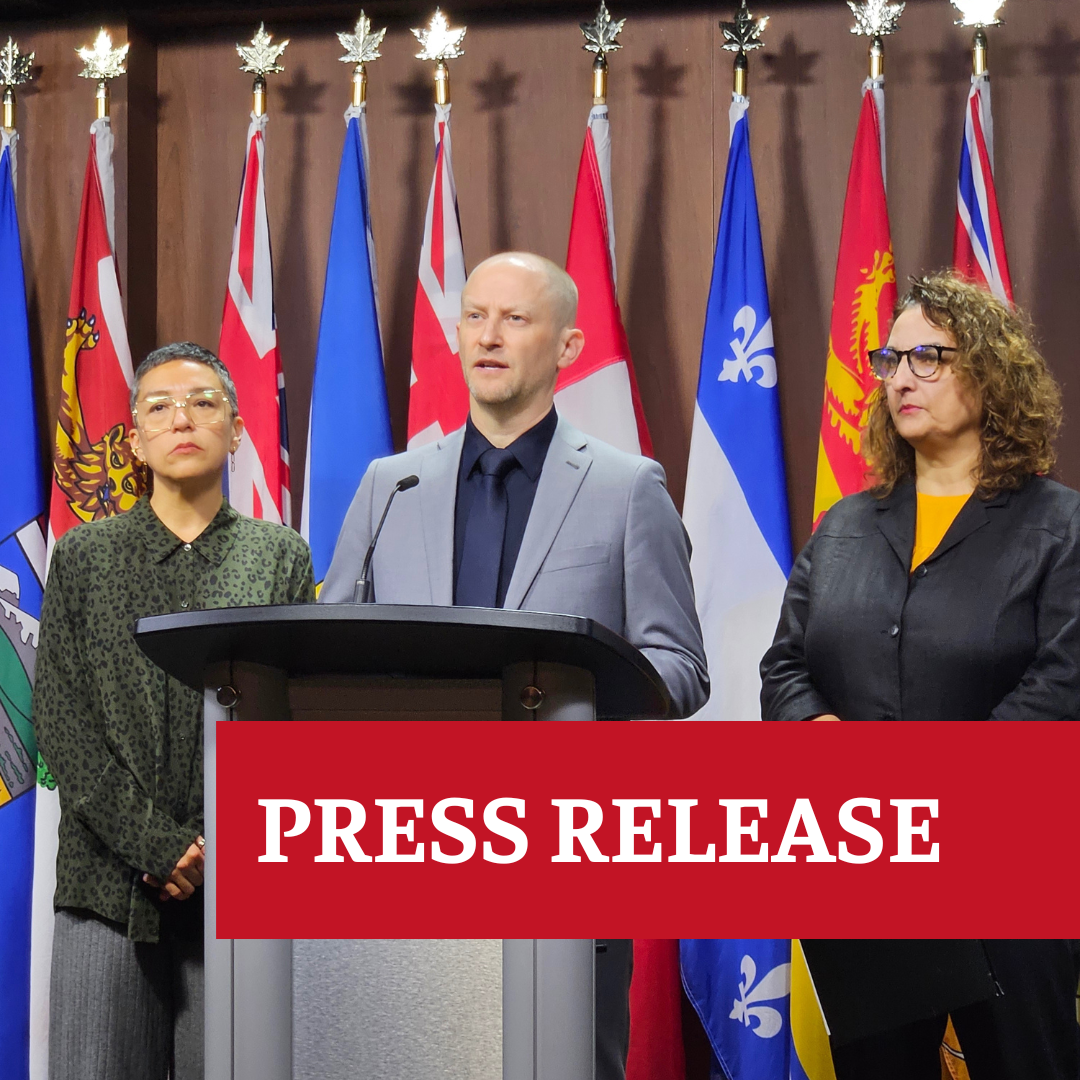
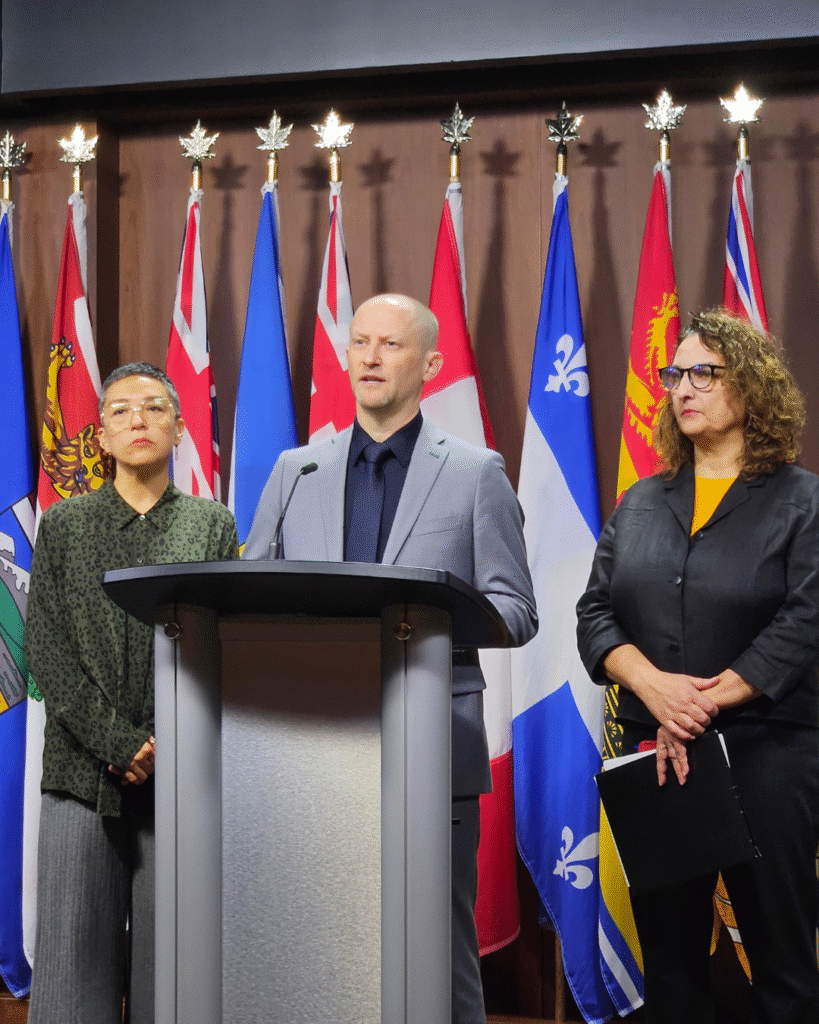
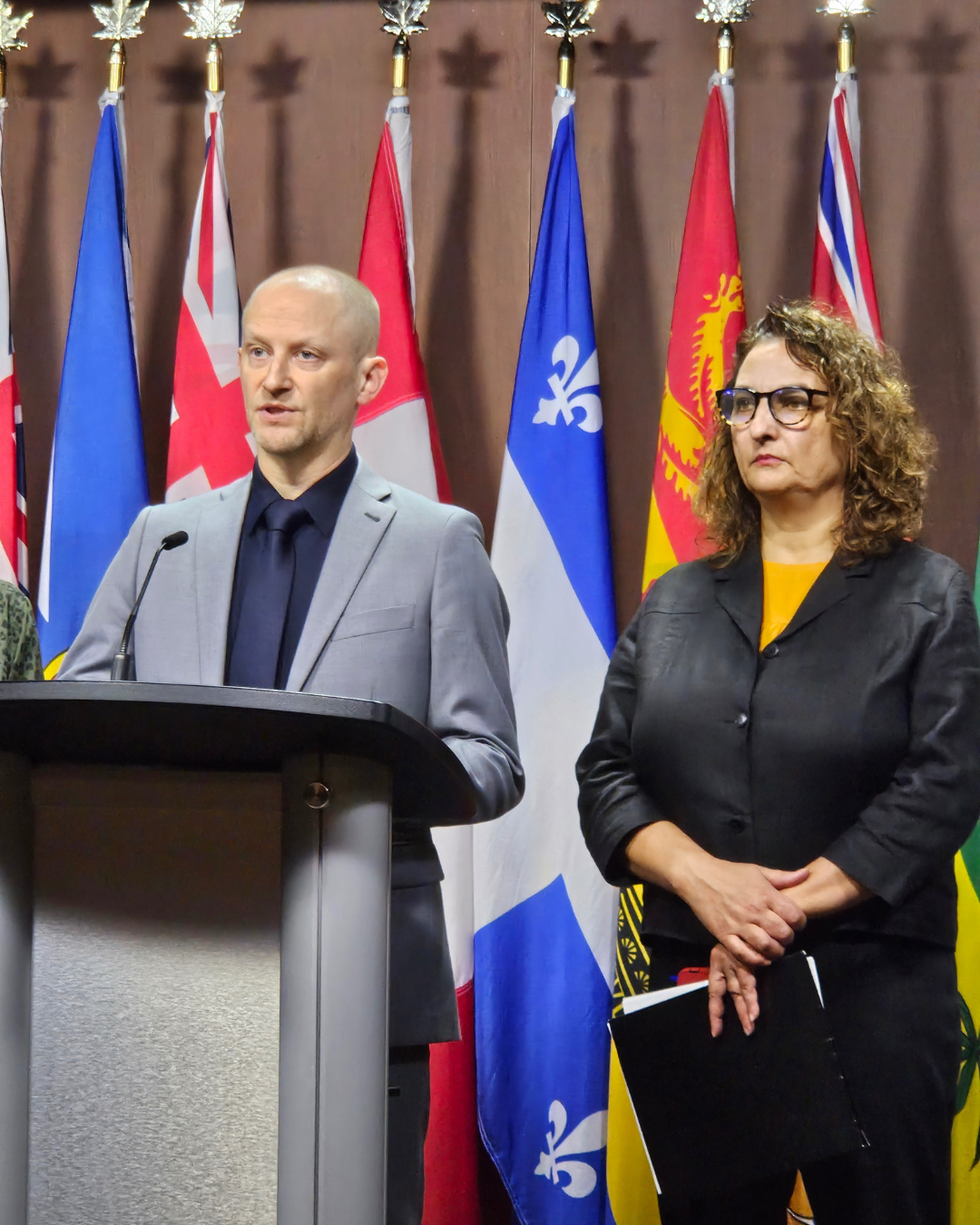
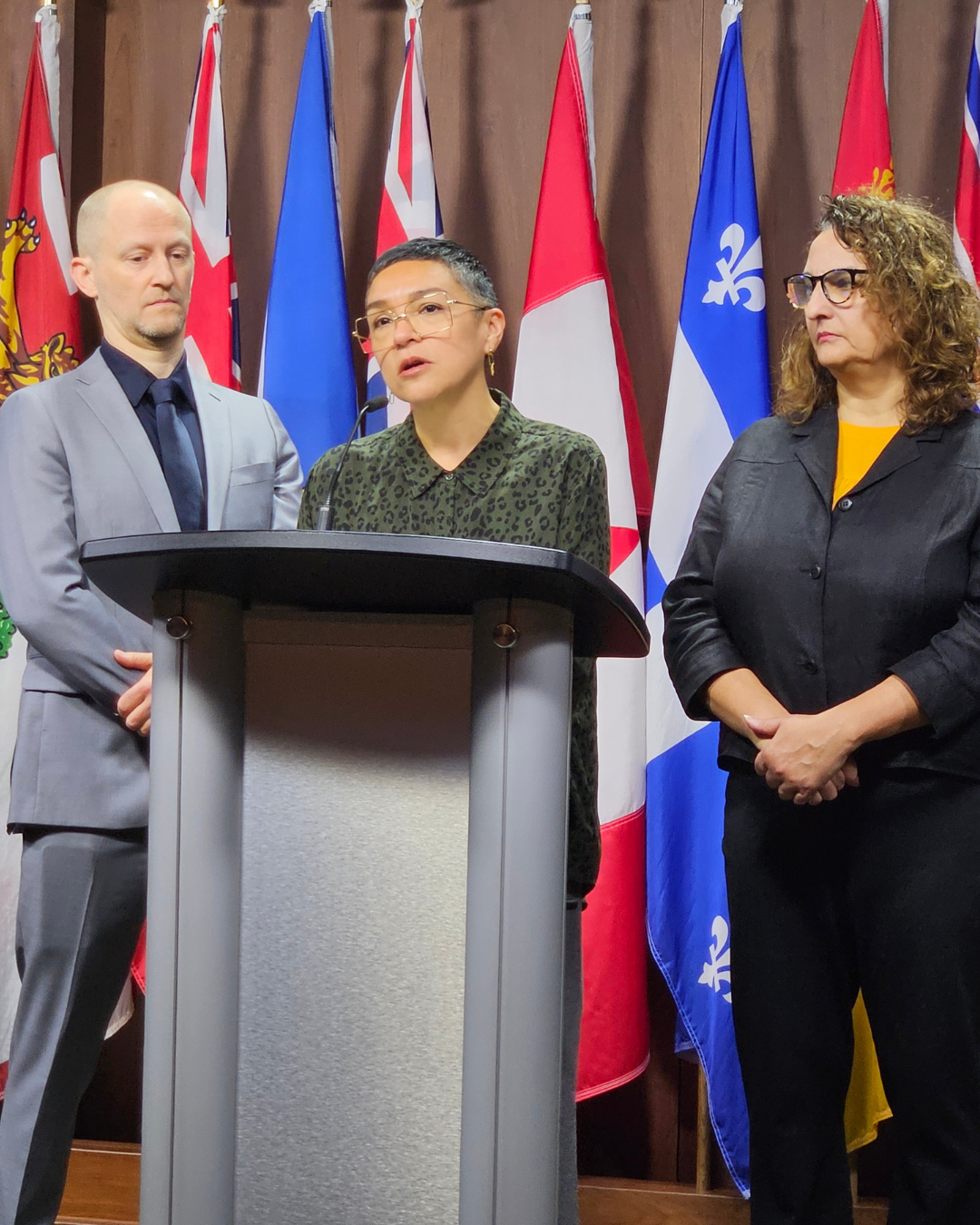
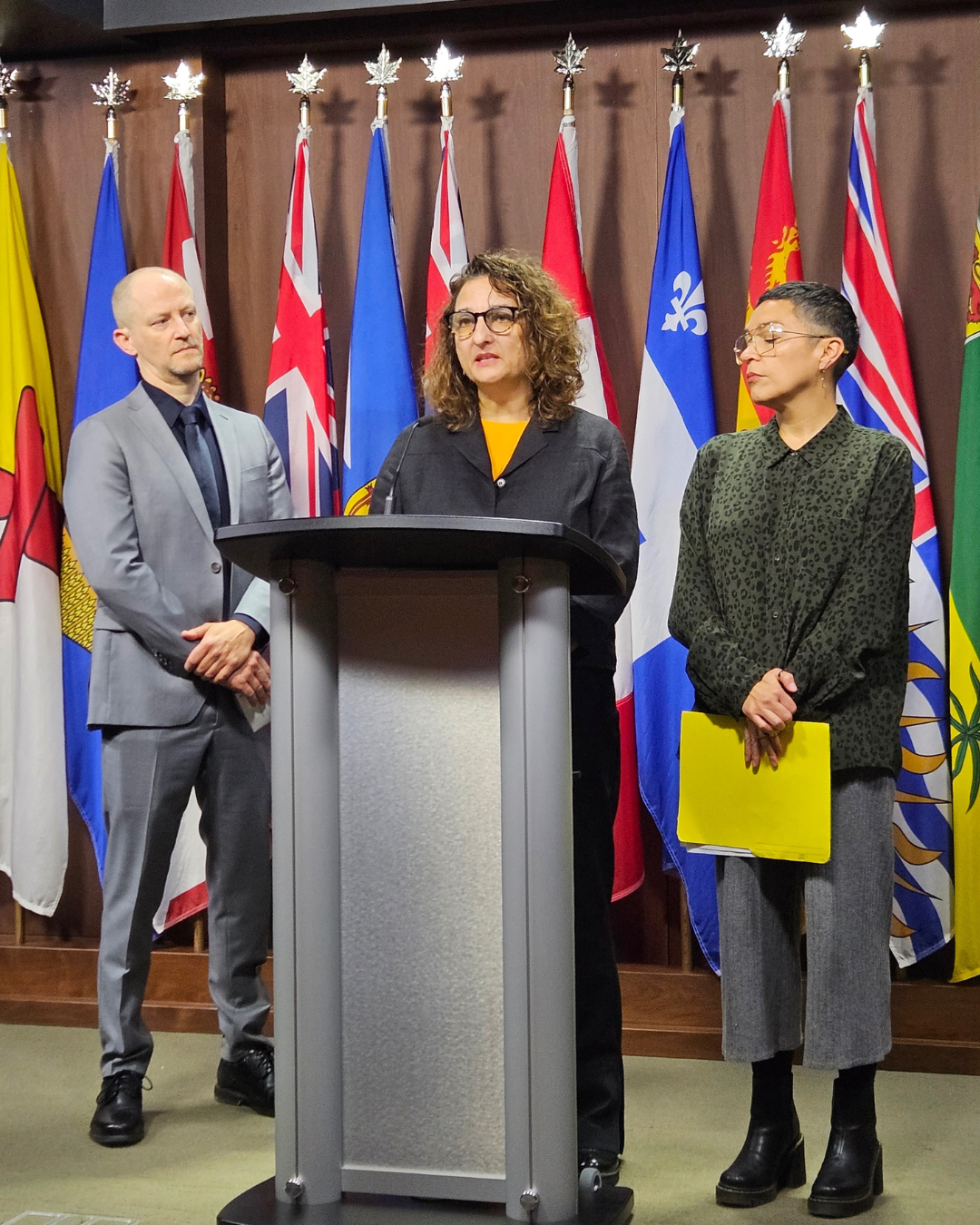
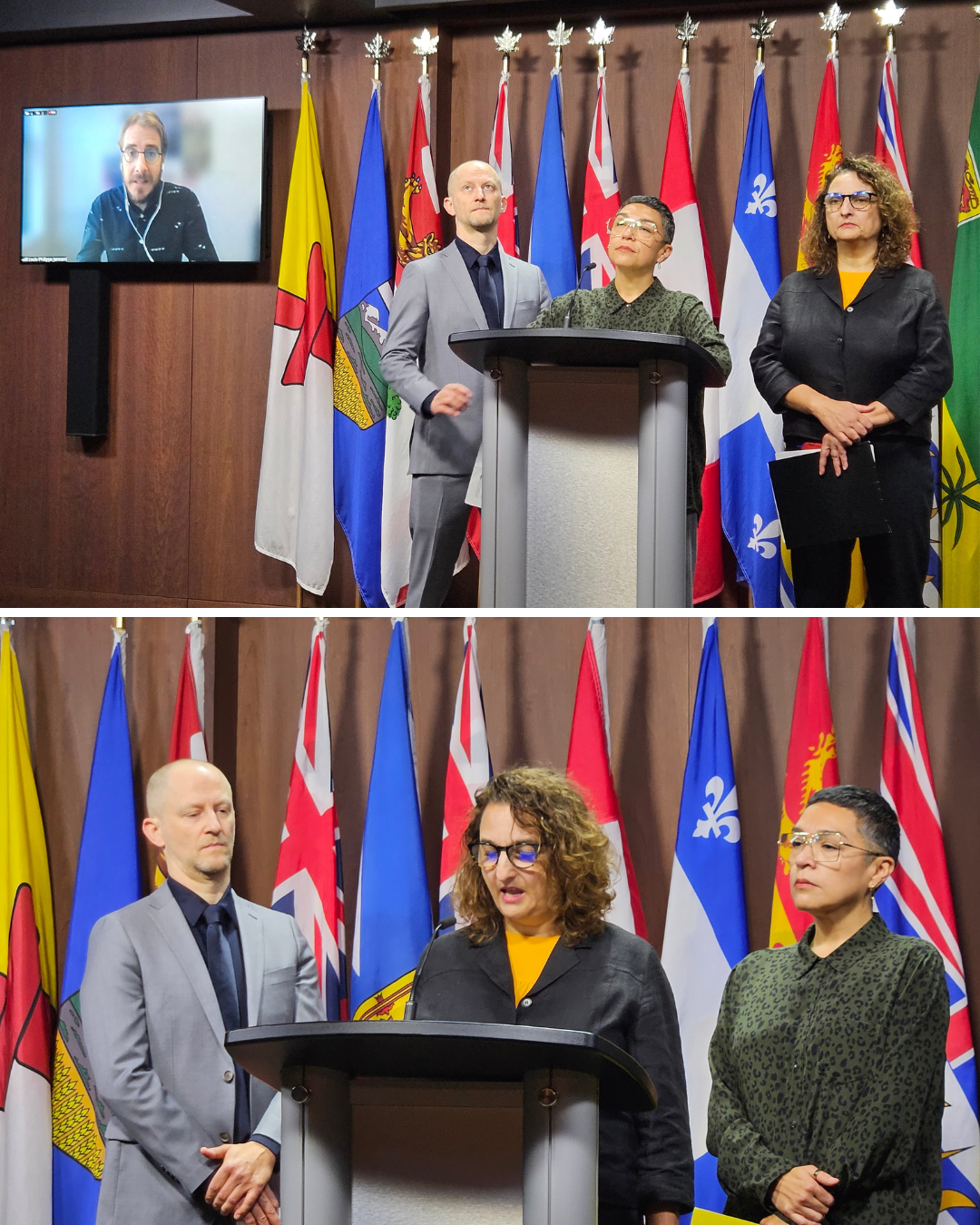
Toronto, ON | March 31, 2026––Today, exactly one year since the Government of Ontario forced nine Consumption and Treatment Services sites (CTS, also known as supervised consumption sites, or SCS) to close across the province, more than250organizations — led by the HIV Legal Network, the Drug Strategy Network of Ontario, and the Canadian Drug Policy Coalition — have sent a clear message to the Government of Ontario. Together, they are calling on the government to respect the expert advice of organizations with unparalleled experience on substance use issues, follow the mounting evidence demonstrating the clear need for SCS, and pledge to keep individuals and neighborhoods safer for everyone by reversing the misguided decision to defund the remaining eight funded CTS sites in Ontario.
Despite claims from the province that the closure of CTS sites last March caused no problem, data shared at a media conference today highlight a troubling trend: Ontario-wide datashows a sharp increase in EMS calls (+69.5%) and emergency department use (+67%) for opioid-related overdoses in the period following the forced closure of nine CTS sites in March 2025 under the so-called Community Care and Recovery Act.
“These trends are troubling and warrant very careful scrutiny by the province,” says Dr. Gillian Kolla, Faculty of Medicine, Memorial University. “The timing and magnitude of these increases are consistent with concerns that were raised at the time of the closures to the Government of Ontario by countless public health experts, including their own internal advisors. The government has an obligation to take these trends seriously and to consider what role the removal of supervised consumption services may have played.”
In the City of Toronto,EMS calls for opioid-related toxicities have increased by82% since the closures of CTS sites, rising from 192 calls in March 2025 to 350 monthly calls in January 2026, a sharp upward shift consistent with what experts warned would happen following site closures, and starkly at odds with the prior downward trend. In Hamilton, where the city’s CTS closed in April 2025, opioid-related EMS responses rose from 66 in April 2025 to 199 in February 2026 — the highest recorded monthlycount since reporting began. Taken together, these trends raise serious concerns about the flawed and ultimately inconclusive Alberta crown corporation study recently invoked by the Ontario government to justify the closures.
The eight remaining sites to be defunded in June 2026 have served 120,997 unique people and reversed 15,402 overdose emergencies, aided by exceptional client-provider relationships and an impressive suite of wraparound services, including primary healthcare, voluntary addiction and mental health treatment opportunities, specialized social supports, and more.
“As someone who has experienced both sides of the system, harm reduction is not theoretical to me — it is life-saving,” says Akosua Gyan-Mante. “I’ve gone from being a service user to now supporting others on the frontlines, and I’ve seen firsthand how compassion, dignity, and non-judgment can keep people alive long enough to access care and build stability.”
Harm reduction initiatives and SCS are also proven to reduce Ontario’s tax burden by preventing HIV and hepatitis C transmission, among other cost-saving benefits.
“The closure of these sites, and the wider and illogical attack on harm reduction in Ontario and across Canada, is deeply worrisome and already proving deadly,” says Sandra Ka Hon Chu, Co-Executive Director of the HIV Legal Network. “Starving supervised consumption sites of funding and pressuring people into an abstinence-only model — including HART Hubs — will not work. Supervised consumption is a key part of the response to the crisis of our toxic, unregulated drug supply: it cannot be replaced.”
“We strongly encourage the advancement of drug policies that help, not harm, individual and community health and safety,” says Michael Parkinson, Executive Director of the Drug Strategy Network of Ontario. “The Government of Ontario has a duty to ensure the life, liberty, and security of all of its residents. Intentionally defunding proven interventions guarantees dangerous and expensive results, threatening the relief we all seek and deserve.”
We are calling on the Government of Ontarioto respect the evidence and immediately reverse its disastrous decision to further defund SCS and force their closure during an ongoing public health emergency of historic magnitude.
SFU’s Faculty of Health Sciences and the Canadian Drug Policy Coalition are pleased to announce together that after fifteen years as a project of SFU, the Coalition will begin operations as an independent not-for-profit organization on March 31, 2026.
Together, we have advanced research, policy, and community engagement to address some of the most pressing issues in substance use, human rights and public health. We would like to express our deep appreciation for our time with SFU and the people who have supported our work there, and for the support of the many community members, donors, and partners who have made this work possible.
Operating as an independent not-for-profit organization will better reflect the national scope of our work and allow us to build transparent and accountable governance structures that support community leadership and impact.
What does this mean for you?
Our work continues without interruption. Our priorities and commitment to evidence-informed, community-driven policy change remain the same.
Our partnership with SFU continues. We will continue to collaborate on important research and knowledge mobilization together with researchers and leaders at SFU. CDPC’s Executive Director DJ Larkin remains an Adjunct Professor at the Faculty of Health Sciences.
If you are a donor (thank you!),going forward you will need to make your donation directly to CDPC to support our work. After March 31, 2026, CDPC will no longer receive donations made through SFU. You can make a one-time or monthly donation here.
We want to stay in touch. If you receive email from the Canadian Drug Policy Coalition, you will continue to do so. If you are uncertain and you want to ensure you’re on the list to stay connected, you can sign up here.
Thank you for being part of this work. Your support has helped build a strong foundation for this next phase, and we are excited about what we will continue to achieve together.
If you have any questions, please reach out directly to [email protected]
The Honourable Vijay Thanigasalam, MPP Associate Minister of Mental Health and Addictions Via email: [email protected] | [email protected]
Dear Premier Ford, Minister Jones, and Associate Minister Thanigasalam,
RE: Defunding of all supervised consumption sites in Ontario
On behalf of the organizational signatories below, we urge you to reconsider the decision to defund the last eight provincially-funded supervised consumption sites (SCS) in Ontario. The evidence in support of SCS — provided to you by internal staff and reports as well as recommendations from Ontario’s Chief Medical Officer of Health and the Ontario Association of Chiefs of Police, among others — is unequivocal and validated by decades of research. SCS prevent deaths, injuries, and other negative health impacts disproportionately borne by Ontarians who use drugs; reduce the burden on overtaxed first responders, hospital personnel and social service staff; and reduce both public drug consumption and drug debris.
The eight sites facing June 2026 closure have served 120,997 unique people and reversed 15,402 overdoses while maintaining or improving community safety and providing numerous wraparound services including primary health care. These sites directly provide and/or connect people with addiction and mental health treatment opportunities and have reduced Ontario’s tax burden by millions of dollars annually through the prevention of HIV and hepatitis C transmission. Ontario-wide data following the 2025 SCS closures demonstrate a sharp increase in EMS (+69.5%) and emergency department use (+ 67%) for opioid-related overdoses, as well as an increase of deaths in private residences and outdoor settings.
SCS are an essential part of the ecosystem of community care that includes a wide variety of treatment and supports highly valued by local communities — and not available anywhere else. While HART Hubs offer some supports, they cannot replace SCS and the low-barrier, emergency care they offer when people experience a life-threatening overdose. The intentional exclusion of SCS at HART Hubs as well as the prohibition on needle and syringe distribution creates needless barriers to people accessing broader healthcare and social services. The choice to cut these services represents not only the loss of desperately needed emergency care, but also the fracturing of relationships nurtured between healthcare providers and people who use drugs — relationships that are a pathway to other supports. For example, if someone chooses to pursue abstinence, SCS can support them to connect with abstinence-based care.
Notably, wait times for publicly-funded withdrawal management services, outpatient services, and residential addiction treatment facilities in Ontario can often be several months long, despite recommendations since 2017 for universal, evidence-based, publicly available, voluntary addiction treatment on demand. Further, the pursuit of abstinence is far from a linear process. Following a course of treatment, the immediately increased risk of life-threatening overdose is well-documented. In Ontario, treatment is also provided in the context of an unregulated industry where anyone can offer services. SCS keep people alive until treatment is available or until they can meet their own goals, including but not limited to abstinence.
Effective law and policy must be grounded in evidence, and shifting funding from SCS elsewhere is not supported by evidence or the public at large. Defunding SCS in Ontario will hurt the most marginalized people in our communities, namely people experiencing homelessness, people living in extreme poverty, and people who consume criminalized drugs. The urgent calls are clear from grieving Ontario residents, people who consume or serve people who consume unregulated drugs, health professionals, community safety experts, and more: SCS are an essential service in need of expansion, not elimination.
There is a formidable wealth of experience and expertise on issues of substance use in Ontario available to policy makers. We encourage and remain open to dialogue.
We urge a reversal of the decision to defund SCS.
Signed,
Canadian Drug Policy Coalition Drug Strategy Network of Ontario HIV Legal Network ANCS Sénégal 2-Spirited People of the 1st Nations 2039192 Ontario Inc A Womb With A View Aboriginal Legal Services Access Alliance Action Hepatitis Canada Adam Newman MPC Addiction Services Central Ontario Addictions and Mental Health Ontario Advocacy Centre for Tenants Ontario Africa Network of People Who Use Drugs (AfricaNPUD) AIDS and Rights Alliance for Southern Africa AIDS Bereavement and Resiliency Program Of Ontario (ABRPO) AIDS Committee Newfoundland & Labrador AIDS Committee of Durham Region AIDS Committee of Ottawa AIDS New Brunswick AIVL akzept e.V. Bundesverband für akzeptierende Drogenarbeit und humane Drogenpolitik Alliance for Healthier Communities Alliance to End Homelessness Ottawa Amnesty International Canada (ES) Anglican Diocese of Toronto Anishnawbe Health Toronto AQPSUD ARCH Disability Law Centre ArtHouseTO Asian Community AIDS Services Association des intervenants en dépendance du Québec Association for Humane Drug Policy, Norway Association pour la santé publique du Québec Awen Consulting Services (International Harm Reduction Capacity Building) BC Civil Liberties Association BC-Centre for Excellence in HIV/AIDS Being Alive/People with AIDS Action Coalition Blood Ties Four Directions Centre BOOM Health Bras outaouais Breakaway Community Services Bronx Movil Butterfly- Asian and Migrant Sex Worker Support Network CACTUS Montréal Cambridge council on aging Canadian Civil Liberties Association Canadian Federation of Mental Health Nurses Canadian Mental Health Association – Sudbury/Manitoulin Canadian Mental Health Association – Champlain East Canadian Mental Health Association, Ontario CanHepC Care Through Chaos Casey House CASON CATIE CAYR Community Connections Centre for Addiction and Mental Health Centre on Drug Policy Evaluation Centretown Citizens Ottawa Corporation Centretown Community Health Centre Changemark Research + Evaluation Church of St Stephen-in-the-Fields Clinique juridique Grand-Nord Legal Clinic Coderix Medical Clinic Community Health Project Los Angeles Community-Based Research Centre (CBRC) Comprehensive Treatment Clinic Comprehensive Treatment Clinic – Community Initiatives Cornerstone Housing for Women Cranstoun CUPE 3903 CUPE 5536 CUPE Local 5399 CUPE Ontario DAP Health Harm Reduction Davenport 4 Palestine Davenport-Perth Neighbourhood and Community Health Centre Deliberar ORG DIY Community Health Timmins Doctors for Safer Drug Policy Dopamine Dr Joel Voth Medicine Professional Corporation Drug Injecting Services in Canterbury Trust (NZ) EACH+EVERY: Businesses for Harm Reduction East Coast Prison Justice Society East End Community Health Centre Elementa Elevate NWO Elgin-Oxford Legal Clinic Elizabeth Fry Society of Northwestern Ontario Eurasian Harm Reduction Association (EHRA) European Network of People who Use Drugs CLG Evangel Hall Mission Families for Addiction Recovery (FAR) Feast Centre for Indigenous STBBI Research FightBack! KW Flemingdon Health Centre Fontbonne Ministries Forearms of Change Center to Enable community Fred Victor Freddie Gay Men’s Sexual Health Alliance George Hull Centre for Children and Families Gerstein Crisis Centre Grandmothers Act to Save the Planet (GASP) Guelph & Wellington Poverty Elimination Collaborative Guelph Community Health Centre Harlem United Harm Reduction Australia Harm Reduction Nurses Association / L’association des infirmiers et infirmières en réduction des méfaits Health Equity Alliance of Nova Scotia Health Providers Against Poverty Healthcare for All Coalition HealthRIGHT 360 Hepatitis C Elimination Roadmap Ontario HIV & AIDS Legal Clinic Ontario (HALCO) HIV Justice Network Homeless Youth Alliance HOPS – healthy options project Skopje House Of Sophrosyne Housing Works, Inc. IAVGO Community Legal Clinic Income Security Advocacy Centre (ISAC) Indigenous Harm Reduction Network Indonesian Harm Reduction Network Inner City Family Health Team Inner City Health and Wellness Program, University of Alberta instituto RIA Interfaith Grand River International Network of People who Use Drugs International Network on Health, Hepatitis and Substance Use (INHSU) Into the Outside Mind IRIS Estrie Jean Tweed Centre JM Drama Alumni John Humphrey Centre for Peace and Human Rights Kensington Health Kensington-Bellwoods Community Legal Services Kickstart Medical Kootenay Insurrection for Safe Supply LAMP Community Health Centre Langs Farm Village Association (Langs) Legal Assistance of Windsor Lembaga Bantuan Hukum Masyarakat Mad Studies Hub York University Magpies place volunteer for outreach Mainline Maytree Médecins du Monde Canada – Doctors of the World Canada Médecins du Monde International Network META:PHI Metzineres sccl Mindful Nurse Gardener Inc. Moms Stop the Harm Mothercraft, Breaking the Cycle Moyo Health and Community Services Mozia Women’s Network Society My Brain My Choice Initiative (Germany) National Harm Reduction Coalition National Overdose Response Service National Right to Housing Network Native Child and Family Services of Toronto Neighbourhood Legal Services Neighbourhood Legal Services (London & Middlesex) Inc. Niagara Region Anti-Racism Association Nurse 2 Nurse Peer Support Oasis unité mobile d’intervention OCRINT Ontario Aboriginal HIV/AIDS Strategy Ontario AIDS Network Organisation for the Prevention of Intense Suffering (OPIS) Ostrowski Medicine Professional Corporation PACT de rue PAN Parkdale Activity-Recreation Centre (PARC) Parkdale Community Legal Services Parkdale Queen West Community Health Centre PASAN (Prisoners with HIV/AIDS Support Action Network) PATH: Peterborough Action for Tiny Homes PEERS Alliance Penticton and Area Overdose Prevention Society (P+OPS) People’s Health Movement-Canada Planned Parenthood Toronto Positive Living Niagara Pozitive Pathways Community Services PREKURSOR Foundation Reach Out Chatham Kent (ROCK) RECAP RECLAIM Collective Recovery Care Regent Park Community Health Centre Regent Park Community Ministry Regional HIV AIDS Connection Registered Nurses’ Association of Ontario (RNAO) Registered Nurses’ Association of Ontario, Sudbury & District Réseau ACCESS Network Respect Rx Pharmacy Retired Executives for Social Equity Rideauwood Addiction and Family Services Righting Relations Canada Shelter Health Network Shelter Housing Justice Network Skana Family Learning Centre Skoun, Lebanese Addictions Center SLO Bangers Syrunge Exchange and Overdose Prevention Program Social Development Centre Waterloo Region Social Planning Toronto South African Network of People who Use Drugs South Asian Legal Clinic of Ontario South Riverdale CHC St Felix Centre St. Michael’s Homes Street Cats YYC Street Haven Street Nurses Network Substance Overdose Prevention and Education Network (SOPEN) Substance Use Health Network Sudbury Temporary Overdose Prevention Society Sunset Country Family Health Team The Ally Centre of Cape Breton The Centre for Psychology and Emotion Regulation The Gilbert Centre for Social and Support Services The Neighbourhood Group Community Services The Ottawa Mission The Peterson Foundation The Seeking Help Project The Sidewalk Project Thrive HIV Prevention and Support Toronto Board of Health Toronto Harm Reduction Alliance (THRA) Toronto Indigenous Harm Reduction Toronto Overdose Prevention Society Toronto’s Drug Checking Service and Ontario’s Drug Checking Community Tracking(IN)Justice Project Unison Health and Community Services Up North Harm Reduction Vibrant Community Health VIRCAN Care & Research Inc. Washington Office on Latin America Waterloo Region Community Legal Services Waterloo Region Drug Action Team Welcome Centre Shelter for Women & Families Wellington Guelph Drug Strategy West Neighbourhood House Women and HIV / AIDS Initiative WoodGreen Community Services Workers for Ethical Substance Use Policy Youth RISE YWCA Toronto
As organizations working to advance policies grounded in human rights and public health, HIV Legal Network and the Canadian Drug Policy Coalition strongly condemn the decision by the Government of Alberta to close the last remaining supervised consumption sites in Calgary and Lethbridge and urge its immediate reversal. If left to proceed, this policy decision will result in needless deaths of loved ones, increased rates of preventable injury and transmission of HIV and Hepatitis C, increased strain on overburdened emergency services, and increased drug consumption and debris in public spaces.
The evidence on these issues has been well-established for decades. We note that the Alberta government is attempting to support its decision with its own flawed six-month study that contradicts the overwhelming evidence demonstrating the harmful impacts on communities when a site closes. In Ontario, supervised consumption site closures have been associated with several harms over the past year, including sharp increases in EMS-treated opioid toxicities (+69.5%) and in emergency department visits for opioid toxicities (+67%), as well as an increase of deaths in private residences and outdoor settings.
As experts in drug policy, we emphasize that the rate of toxic drug deaths is directly impacted by the composition and volatility of the unregulated drug supply, which is currently outside of the oversight and control of any regulatory body. Shockingly, the Government of Alberta says now is the time to close these sites because overdose deaths have dropped “about 39 per cent” since a peak in 2023. But 602 people lost their lives in only six months in 2025. We are still in the midst of a toxic drug crisis, and supervised consumption sites are crucial to reducing overdose deaths. Eliminating a critical, evidence-based overdose prevention tool defies all logic.
The supervised consumption site in Calgary alone responded to 475 drug-related events in the first three quarters of 2025. To be clear, these numbers represent lives that would have been lost without the availability of supervised consumption services.
People who use drugs in Calgary and Lethbridge will lose a lifeline when these sites close in June 2026. Removing access to one of the most evidence-based, proven tools available to reduce preventable drug-related deaths and injuries is a reckless choice with clear consequences: more needless suffering. In the context of the volatile, toxic, unregulated drug supply, supervised consumption services are an essential element of a broader approach that includes access to voluntary, regulated, evidence-based substance use treatment. Increased investments in abstinence-based treatment services do not replace the unique and life-saving service provided by supervised consumption. It is well established that working towards abstinence, for those that choose to do so, is not a linear process. For example, the increased risk of life-threatening overdose following substance use treatment is well-documented. By ensuring the availability of a range of evidence-informed services, including supervised consumption, we are better able to support people and reduce preventable deaths. Harm reduction and access to voluntary treatment services go hand in hand.
We stand in solidarity with people who use drugs and their families, as well as frontline workers who will bear the brunt of harm from this policy decision. We are committed to working with allies in Alberta to advance substance use policy that is grounded in evidence and creates safer, healthier communities for every member of our society, regardless of their relationship to substance use.
The HIV Legal Network and Canadian Drug Policy Coalition call on the Government of Alberta to immediately reverse this decision.
Ottawa, Canada | March 24, 2026—Yesterday, the United Nations Human Rights Committee released a report rebuking Canada’s narrow interpretation of the “right to life” and called for action to save and protect lives.
Human rights groups, including the National Right to Housing Network (NRHN), the Canadian Drug Policy Coalition (CDPC), the Canadian Feminist Alliance for International Action (FAFIA), and HIV Legal Network welcomed the report, which follows the Committee’s review of Canada’s implementation of the International Covenant on Civil and Political Rights (ICCPR) earlier this month.
“This is a significant and necessary correction,” says Michèle Biss, Executive Director of the National Right to Housing Network. “Canada has treated international human rights obligations as largely symbolic. The Committee has now made it clear: as a party to international human rights treaties like the International Covenant on Civil and Political Rights, Canada has made binding commitments that require real action—especially in the face of preventable deaths.”
The UN Committee expressed surprise during the review when Canada’s delegation stated that Canada does not accept the Committee’s authoritative findings that the right to life imposes “positive obligations” on governments to ensure access to essential health care, address homelessness, the drug toxicity crisis, or climate change.
Canada has not changed its position despite the Committee consistently affirming that protecting the right to life requires states to adopt “positive measures” and to address “general conditions in society” that threaten life. “Positive measures” require states to take proactive steps to guarantee rights, rather than merely refrain from violating them. This means tackling the root causes of preventable deaths, including homelessness, poverty, and the drug toxicity crisis. Notably, Canada had previously earned an “E” grade for rejecting a Committee decision affirming these principles in Toussaint v Canada.
In their report, the United Nations Human Rights Committee highlighted:
Rising drug toxicity deaths: The Committee expressed particular concern about “the very high number of deaths related to drug toxicity,” which “affects persons experiencing homelessness and poverty and disproportionately affect Indigenous persons.” Drug policies must be primarily based on “public health, harm reduction and human rights considerations.” This acknowledgment reinforces the need for a coordinated, rights-based response to overlapping crises and effective access to services, including harm reduction services. This is of particular importance at a time where both Ontario and Alberta have just announced the closure of many supervised consumption services by mid-June.
Lack of implementation mechanisms: Critically, Canada currently has no effective domestic mechanism to receive, coordinate, and implement recommendations from international human rights bodies. Without such a mechanism, Canada is failing to meaningfully act on guidance from the international community—including recommendations that could help address homelessness and unregulated drug toxicity to prevent further loss of life.
Gaps in the legal system: Canada is not doing enough to ensure that its international human rights obligations are understood and applied within its own legal system. The Committee called on Canada to strengthen awareness of the ICCPR among judges, prosecutors, and lawyers so that these obligations are meaningfully considered in domestic court decisions—an issue with profound implications for cases involving housing, homelessness, access to essential health and social services, and encampments.
Encampment evictions and rights violations: The Committee expressed concern about the use of extraordinary legal measures, including the notwithstanding clause, an issue that has tremendous impact on people marginalized by policy. For example, provincial governments threaten encampment residents with eviction despite positive court decisions without providing access to safe and adequate housing alternatives.
“We strongly support the Committee’s call for Canada to take ‘all necessary steps’ to address these concerns through effective mechanisms across federal, provincial, and territorial governments, and to ensure access to remedies through domestic courts,” says Beeta Senedjani from the Canadian Drug Policy Coalition, speaking on behalf of a coalition of human rights groups. “We also endorse the call for Canada to establish a national mechanism to monitor implementation and to ensure that individuals can seek enforcement of the Committee’s decisions.”
These recommendations build on the Committee’s longstanding position that the right to life requires governments to take positive measures to provide access without delay to shelter, social housing programs, and health care—a principle reaffirmed in its General Comment No. 36 and reinforced in the current review.
“We call on the federal government to respond urgently and meaningfully to the Committee’s findings,” says Biss. “We specifically await a response from Canadian Heritage Minister Marc Miller, Housing Minister Gregor Robertson, and Health Minister Marjorie Michel outlining how Canada will fulfill its obligations to international human rights law and the right to life.”
“The message from the Committee is clear,” says Senedjani. “Canada cannot continue to deny its responsibilities while people are dying preventable deaths. The right to life must include the right to live with dignity—and that starts with ensuring access to adequate housing and lifesaving health services.”
March 4, 2026 | Geneva — Today in Geneva, United Nations Human Rights Committee members expressed surprise at Canada’s claim that Article 6 of the International Covenant on Civil and Political Rights (ICCPR) does not require governments to take positive measures to protect life when it is at risk.
In a joint statement ahead of the Committee’s review of Canada’s ICCPR compliance, human rights groups had called on the Committee to press Canada to accept that the right to life requires governments to take positive measures to address systemic conditions that place lives at risk. These conditions include homelessness, lack of access to essential healthcare, toxic drug deaths, violence against Indigenous women and girls, food insecurity, unsafe water, inadequate disability supports, and climate change.
“In case after case, Canadian governments argue that even when people are dying, they have no constitutional duty to act,” says Michèle Biss, Executive Director of the National Right to Housing Network. “The right to life means more than simply refraining from harm. It requires governments to prevent foreseeable loss of life.”
The United Nations Human Rights Committee monitors Canada’s compliance with the ICCPR, which guarantees the “inherent right to life” in Article 6. This is the first time the committee has reviewed Canada since 2015. The Committee has consistently affirmed that protecting the right to life requires states to adopt “positive measures” and to address “general conditions in society” that threaten life. “Positive measures” require states to take proactive steps to guarantee rights, rather than merely refrain from violating them.
Today, committee members questioned Canada’s restrictive interpretation of the right to life, which includes denying any obligation to ensure access to health care when life is at risk. Committee members further raised concerns about Canada’s reliance on punitive responses to drug use and homelessness rather than addressing serious risks to life. Committee members referred to the Committee’s General Comment No. 36 (2018), which affirms that protecting the right to life requires states to adopt “positive measures” and to address “general conditions in society” that may threaten life, including inadequate health care, homelessness, toxic drug deaths and environmental degradation. Canada has rejected this interpretation in its submissions to the Committee and in litigation before domestic courts.
Domestically, Canada has opposed arguments invoking positive rights made under section 7 of the Canadian Charter of Rights and Freedoms, asserting that governments are not legally required to take positive measures—even where evidence shows that lives are in foreseeable danger. Canada has made these arguments in cases where individuals have invoked their right to life in response to homelessness, denial of health care, climate inaction, or the closure of supervised consumption sites.
“Canada’s refusal to fully uphold the right to life has allowed for thousands of preventable deaths across the country,” says Beeta Senedjani of the Canadian Drug Policy Coalition. “We are hopeful the committee will hold Canada to account and spur the changes we need to ensure all people in Canada can be healthy and safe.”
The coalition calls on the Committee to recommend that Canada:
Affirm that the right to life requires positive measures to protect life, consistent with the Committee’s jurisprudence;
Review and revise its domestic litigation positions to ensure consistency with its international human rights obligations;
Implement the Committee’s Views in Toussaint v. Canada; and
Ensure access to effective remedies for systemic violations of the right to life.
“Courts in Canada have held that international human rights laws are not abstract, aspirational principles,” says Sandra Ka Hon Chu, Co-Executive Director for the HIV Legal Network. “The Charter is presumed to provide protections as outlined in the international human rights treaties it has ratified.”
Canada’s Position on Positive Obligations Under Article 6 (Right to Life) NGO Joint Statement – Summary of Key Issues
The Legal Issue
Article 6 of the ICCPR protects the inherent right to life. The United Nations Human Rights Committee has clarified — beginning with General Comment No. 6 (1982) and reaffirmed in General Comment No. 36 (2018) — that this right requires positive measures to address systemic conditions that pose foreseeable threats to life.
These include environmental degradation, homelessness, hunger, substance use, and the denial of essential deprivation of essential health care and public services.
In Toussaint v Canada (2018), the Committee applied this interpretation to Canada, finding that denying essential health care to an irregular migrant exposed her to a reasonably foreseeable risk to life, in violation of Article 6. The Committee directed Canada to prevent similar violations in the future by ensuring access to essential health care where life is at risk.
Canada’s Position
Canada has:
Rejected the Committee’s interpretation that Article 6 requires positive measures addressing socio-economic conditions;
Stated it does not accept that the right to life includes a right to live with dignity where this might entail socio-economic obligations;
Declined to implement the Views in Toussaint because it does not agree with the Committees findings
Advanced arguments in domestic litigation, asserting that the right to life in section 7 of the Charter does not impose positive obligations to provide life-saving benefits or address systemic threats to life.
This position, when upheld by courts, has meant that individuals whose right to life under international law have been violated have no effective remedies under the Canadian Charter. Canada has an obligation to ensure access to effective remedies, requiring that the Charter of Rights be interpreted consistently with Canada’s obligations under international human rights law.
Systemic Impacts
The consequences of rejecting positive obligations under the right to life are evident across multiple areas:
Homelessness Deaths among people experiencing homelessness are rising, with significantly reduced life expectancy.
Essential Health Care Irregular migrants lack access to essential health care necessary to protect their lives. Lack of access to mental health services remains a systemic problem, with suicide a leading cause of death among youth. Indigenous peoples experience markedly reduced life expectancy and unmet health needs.
Substance Use Canada’s criminal laws make the unregulated drug supply more unpredictable, contaminated and potent, driving thousands of foreseeable, preventable deaths annually. Meanwhile, governments continue to argue that they have no obligation to provide, fund, or ensure the availability of proven lifesaving services to protect the right to life, including supervised consumption or safe supply.
Missing and Murdered Indigenous Women and Girls Indigenous women and girls face disproportionate rates of homicide. Most Calls for Justice from the National Inquiry remain unimplemented.
Disability Supports Inadequate social supports leave some persons with disabilities seeking Medical Assistance in Dying due to poverty and deprivation rather than irremediable suffering.
Water and Sanitation Dozens of long-term drinking water advisories remain in First Nations communities.
Food Insecurity Approximately one in four people in Canada live in food-insecure households, a condition linked to premature mortality.
Climate Change Canada is not on track to meet its Paris Agreement targets and is particularly vulnerable to the effects of climate change. Extreme heat and wildfires have already resulted in documented loss of life and serious health impacts.
What the Coalition Is Requesting
The coalition calls on the Committee to recommend that Canada:
Publicly affirm that the right to life in Article 6 requires positive measures to address systemic threats to life;
Align its domestic litigation positions with its international human rights obligations;
Implement the Committee’s views in cases involving the right to life that have been denied effective remedies
On January 14, 2026, the province of B.C. announced it would end its limited decriminalization policy and reinstate criminal penalties for personal drug possession.1 The province’s decision not to renew its decriminalization policy appears to have been informed – not by the province’s own data indicators, not by public health and safety experts, not by people most affected, not by health professionals – but by backroom political strategists, whose chief concern is their own hold on power.
This return to criminalizing and punishing people for their substance use is a step backward. More than that: by so thoroughly and disingenuously fumbling the potential of this initiative, the province of B.C. has done a deep and lasting disservice to people harmed by the unregulated toxic drug crisis worldwide.
WHAT HAPPENED?
Yesterday, B.C. Minister of Health Josie Osborne announced that the province would not seek to extend its decriminalization policy when it expires on January 30, 2026.
The policy, introduced as a three-year pilot project in 2023, had removed criminal penalties for the personal possession of small amounts of some currently-illegal substances. The stated goal of the decriminalization pilot was to “reduce stigma and fear of criminal prosecution that prevents people from reaching out for help, including medical assistance.”2
This announcement comes despite the province’s own data demonstrating the policy’s early successes.
POLITICS AS POLICY
There are limits to the influence that evidence has on government policy choices. This is why we must situate evidence within the social, economic, cultural and political context in which policy is made and implemented. So before we look at the available data around decriminalization and assess the province’s stated reasons for axing it, let’s examine the context for this policy decision.
People in B.C. are experiencing a housing crisis and cost-of-living crisis that have combined to force record numbers of people to live in public spaces, in tents and in shelters. The unregulated drug supply is unpredictable and frequently contains additives with complex effects on the human body. This is hell for those experiencing it, and can be uncomfortable, upsetting and disruptive for those who witness it. It would be difficult not to witness it: with significant increases in the number of people homeless across B.C. and lack of accessible low-barrier services in most communities, the deprivation and suffering of people harmed by oppressive systems has become highly visible in recent years.
Not wanting to let the nuances of causation deny a pithy soundbite, it was in this context that opposition politicians took aim at the policy. Decriminalization offered a novel and highly visible scapegoat at which they could direct their constituents’ fears and frustrations. And they did.
In a media environment that rewards conflict, many news outlets amplified politicians’ fearmongering narratives – sometimes without question, reducing the systemic down to the sensational, blaming decriminalization for the broader issues at play, and obscuring the more complex realities facing British Columbia communities.
In determining the policy’s future, the province’s own data showing promising impacts fell short when stacked against the firestorm of public opinion and moral panic. The B.C. government was not only unwilling to defend the merits of its own policy, but eventually adopted and amplified the sensational language itself, giving credence to the false narrative of decriminalization as the central cause of community challenges.
There are lessons to be learned here: not only about the specifics of policy design and implementation, but also about the vulnerability of policy to those peddling fear- and anger-driven narratives.
B.C.’s RATIONALE FOR ENDING DECRIMINALIZATION
At the announcement, Minister Osborne stated that the reason the province has chosen to return to criminalizing people who use drugs is that the policy “hasn’t delivered the results that we hoped for.” The province’s own positive and promising data indicators suggest that it was on track to deliver many of the results it sought. B.C.’s reports further cite evidence from other jurisdictions that indicates “it takes years for many health and other outcomes to fully emerge.”3
In answering media questions – of which there were many, and pointed – the Minister shared that the data did not show the desired increase in self-referrals to care, or use of certain services, though provided details were scant on which services she meant.
This claim does not appear to be supported by the data the B.C. government reported to Health Canada, which notes that “core service utilization indicators are stable or increasing since decriminalization.”4
In answering media questions, the Minister also noted that during the three-year exemption, there was not a measurable decrease in stigma, and that the public conversation “has become very challenging.” It is important to note here the province’s role over that time in fueling and entrenching the very stigma decriminalization sought to decrease, by amplifying misleading narratives.5
Taken together, the data tells a different story than the Minister. Rather than a policy failure, this is a failure of government to address the structural issues driving visible poverty and homelessness, a failure to do the proactive engagement and dialogue to help the public understand a novel policy change in context, a failure to meaningfully respond to politically-motivated moral panic, and ultimately, a failure to support a policy that showed promise in reducing harm and helping people.
TO THE DATA: WHAT WERE THE RESULTS OF THE DECRIMINALIZATION PILOT?
By the B.C. government’s own measures, decriminalization was achieving its policy goals.6 For example, in a key element of decriminalization, offences and seizures decreased. This is important because evidence shows that fear of criminal sanction can prevent people from accessing services, and involvement with the criminal legal system can drive harms like losing housing or employment, and increasing risk of overdose.7
Another desired outcome of the project was to increase awareness of and comfort accessing health and social services, and increased connections to those services. Data in B.C.’s reporting to Health Canada appears to show positive results here as well: “data…suggests that core service utilization indicators are stable or increasing since decriminalization.”
In addition to B.C.’s measured indicators on accessing services, a recent peer-reviewed study in Vancouver found that young people reported being less likely to be deterred from accessing harm reduction services because of fear of police.8
Further data showed ambulance calls decreased. At least initially, visits to Overdose Prevention Services were up. There was no observed increase in Substance Use Disorder diagnoses, including in youth.9
It is important to note that B.C.’s decriminalization model had significant flaws in its design and implementation, several of which were identified prior to launch by People Who Use Drugs, community groups, and academics.10 Contextually, during the policy’s implementation, the province saw significant increases in the number of people experiencing homelessness and poverty. And, despite these flaws and contextual realities, and by the province’s own measures, decriminalization in B.C. showed notable successes and promise.
DEFLECTION
As with all sleight of hand tricks, the Health Minister made an effort to refocus attention away from the shaky policy logic of the announcement. Here we saw once again, government turn to promoting access to treatment – specifically the expansion of Access Central, a phone line that exists to connect people with health services and supports – as B.C.’s new policy direction. We can assume, however, that as informed, diligent public servants, the Minister, her staff, and the policy analysts behind the scenes know: treatment alone is an individual response to a systemic issue; it is insufficient and inappropriate to tout it as a cure-all response to the unregulated toxic drug crisis. Without taking anything away from what may be a worthwhile service, it is misleading to speak of Access Central, or any treatment-focused intervention, as an appropriate policy substitution for decriminalization. Instead, in this context, it reads more like narrative management, a distraction from the province’s decision to return to criminalization and its attendant harms.
The expansion announcement reframes the issue as an individual problem with individual solutions. It further implies that help exists at sufficient scale when it does not, and – as outlined in CDPC’s Addiction Treatment position statement –much of the help that does exist is unregulated, inaccessible, and poor quality.11
WHAT WE DO KNOW (AND HAVE THE EVIDENCE TO BACK UP)
The main driver of death and harm today remains the unregulated, toxic drug supply.1213Criminalization makes the unregulated supply more dangerous. Despite yesterday’s announcement, the broad base of evidence that supports decriminalization has not changed. Decades of data show that policing, arresting, charging, and jailing people for their substance use increases harm, while doing nothing to reduce drug use or increase safety. That is why we still need decriminalization.
Decriminalization is one necessary piece of a much larger puzzle that includes housing, health care, voluntary treatment, and a regulated supply. It could never address housing shortages, cost-of-living pressures, and toxic drugs. What it could and did do, by the province’s own metrics, is reduce some of the harm connected to the criminal legal system, reduce barriers that stop people from connecting to supports and services, and reduce the fear that drives people to hide their substance use.
This decision reflects politics, not evidence. The facts haven’t changed. The need for decriminalization hasn’t either.
Ministry of Health. (2026, January 14). Minister’s statement on status of the decriminalization pilot program [Press release]. Government of British Columbia. https://news.gov.bc.ca/releases/2026HLTH0003-000031↩︎
For insight on PWUD experiences of stigma in year one of the decriminalization policy, see: Ali, F., Russell, C., Torres-Salbach, S., Lo, M., Bonn, M., Bardwell, G., Budau, J., Hyshka, E., & Rehm, J. (2025). Experiences of stigmatization among people who use drugs in the initial year of British Columbia’s drug decriminalization policy: A qualitative study. International Journal of Drug Policy, 139, 104791. https://doi.org/10.1016/j.drugpo.2025.104791 https://www.sciencedirect.com/ science/article/pii/S0955395925000908↩︎
McAdam, E., Milloy, M.-J., Sayre, E. C., Verdicchio, C., Sedgemore, K., May, H., Pranteau, S., Corriveau, D., Friesen, D., Fleury, M., Fast, D., & DeBeck, K. (2025). Policing and access to harm reduction services among young people who use drugs and young Indigenous people who use drugs before and after the pilot implementation of decriminalization of personal possession. International Journal of Drug Policy, 146, 105068. https://doi.org/10.1016/j.drugpo.2025.105068↩︎
Gonzalez-Nieto, P., Wallace, B., Kielty, C., Gruntman, K., Robinson, D., Substance Staff, Arredondo Sanchez Lira, J., Gill, C., & Hore, D. (2025). Not just fentanyl: Understanding the complexities of the unregulated opioid supply through results from a drug checking service in British Columbia, Canada. International Journal of Drug Policy, 138, Article 104751. https://doi.org/10.1016/j.drugpo.2025.104751↩︎
Blocked From Testifying, Civil Society Groups Urge Withdrawal of Bill C-12 Citing Threats to Human Rights and to Fundamental Justice
OTTAWA, Nov. 24, 2025 –A broad coalition of groups from across Canada is sounding an urgent alarm in advance of a critical parliamentary vote on Bill C-12.
The bill would open the door to discrimination and violations of human rights and due process in Canada’s immigration system, authorize sharing of sensitive personal immigration information, and expand dangerous approaches to drug policy. Yet it is being pushed through parliament with minimal debate while those that will be impacted by its sweeping changes are locked out of the process.
“This deeply concerning and highly controversial legislation will put many refugees in danger, risking their return to persecution in violation of rights protected under the Charter and international law,” said Gauri Sreenivasan, Co-Executive Director of the Canadian Council of Refugees. “And yet the bill is moving at break neck speed through Parliament while those with expertise and lived experience who want to advise on its dangers are shut out of the process. Neither the law nor the public interest is being served.”
The bill will deny many refugees access to fair and independent assessment and full appeal of their claims by the Immigration and Refugee Board because of arbitrary time limits and exclusions. This approach will not streamline Canada’s processing of refugee claims, but will lead to lower quality decisions while shifting backlogs to our already overburdened Federal Courts and to IRCC.
The bill will also compound harm arising from the Canada-US Safe Third Country Agreement, which abandons many refugees to the U.S. immigration system at a time when well documented human rights violations have become the dominant feature of that system.
”Bill C-12 would deny protection to vulnerable people irrespective of changes to their personal circumstances or political conditions back home. So many people like me, who sought safety here and have made lives here, would be shut out by this Bill. This isn’t just policy, it’s people’s lives,” said Tonny Muzira, Co-Founder & Director of Advocacy and Partnerships Centre for Black Development Options Canada. “Canada cannot turn its back on those seeking safety.”
Under Bill C-12, the government will also be able to cancel or suspend immigration documents and applications based on an undefined assessment of the “public interest”. This power grants dangerous discretionary power to the government without any individualized assessment or procedural safeguards.
“The bill sets up open-ended powers with little thought to the consequences and inevitable abuse”, said Louis-Philippe Jannard, of the Table de concertation des organismes au service des personnes réfugiées et immigrantes (TCRI). “We haven’t seen such broad, discretionary powers in our immigration system since the 1970’s, when their abuse led to rampant discrimination and fatal decisions.”
Bill C-12 would also authorize the government to share highly sensitive immigration information with few limitations. This includes changes in gender identity and the status of any refugee claimants, exposing vulnerable people in Canada to severe risk.
“Broad dissemination of sensitive personal information can place migrants and refugees at significant risk of discrimination and persecution in Canada and abroad”, said Tamir Israel, Director of the Canadian Civil Liberties Association’s Privacy, Surveillance and Technology Program. “Despite this significant potential for abuse, Bill C-12 lacks minimum safeguards like the need to ensure information sharing is necessary and proportionate.”
Bill C-12 also doubles down on prohibition-based drug policy that has demonstrably failed to protect public health and safety.
“Instead of funding affordable housing and other health and social supports, Canada is supporting U.S.-led militarized drug enforcement,” said Nick Boyce, from the Canadian Drug Policy Coalition. “If Canada follows this path, it will be complicit in violations of international human rights law.”
In disregard of the dire risks posed by this legislative proposal, the bill has been fast-tracked and received minimal consideration in Parliament. It is scheduled for a final vote by the Standing Committee on Public Safety tomorrow—just three weeks after its study of the bill began.
Despite the highly attenuated timeline, dozens of refugee and migrant groups, human rights groups, labour organizations, health advocacy groups, representatives of the Black community, gender based violence groups, legal professional bodies, drug policy groups and others requested to speak at committee hearings but were denied. They have also submitted briefs expressing concern regarding Bill C-12’s consequences.
These groups were largely absent from committee proceedings and MPs will not have the time to consider the long list of concerns raised by these submissions. In contrast, MPs heard repeatedly from border and policing agencies and officials. The end result is that the voices of those most impacted by Bill C-12 have not been heard.
“MPs and the public should be extremely concerned that the government is fast-tracking legislation that will only multiply the possibility of discrimination, exploitation, and violations of human rights,” said Karen Cocq of the Migrant Rights Network. “ This government got elected promising to reject Trump-style politics, but Bill C-12 is the opposite of that. This bill cannot be fixed, it must be withdrawn.”
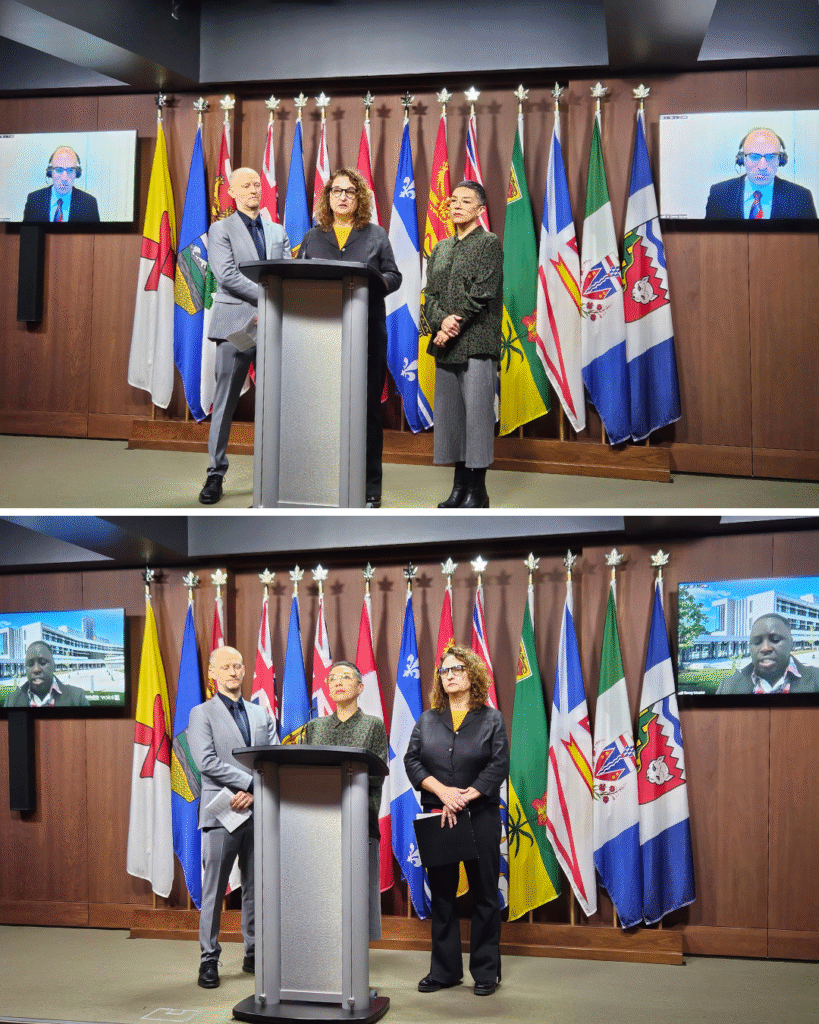
Images from the Ottawa, ON press conference featuring in-person speakers Nick Boyce, Gauri Sreenivasan and Karen Cocq, and Zoom speakers Louis-Philippe Jannard, Tonny Muzira and Tamir Israel.
POUR DIFFUSION IMMÉDIATE
Des organisations de défense des droits sonnent l’alarme à la veille d’un vote crucial sur le projet de loi C-12
Empêchés de témoigner, des groupes de la société civile demandent le retrait du projet de loi C-12 en invoquant des menaces aux droits humains et aux principes de justice fondamentale.
OTTAWA, 24 novembre 2025 – Une large coalition pancanadienne d’organisations sonne l’alarme à la veille d’un vote crucial à la Chambre des communes sur le projet de loi C-12.
Le projet de loi ouvrirait la porte à la discrimination, aux atteintes aux droits humains et au non-respect de principes d’application régulière de la loi au sein du système canadien d’immigration, il autoriserait le partage d’informations personnelles sensibles en matière d’immigration et approfondirait des approches dangereuses relatives aux politiques sur les drogues. Le gouvernement accélère toutefois son étude au parlement, avec des débats limités, alors que les personnes et les groupes qui subiront les effets de ces changements majeurs ne sont pas entendus.
« Cette proposition législative profondément inquiétante et controversée plongera plusieurs personnes réfugiées dans des situations dangereuses, à risque de retour vers la persécution, en violation des droits protégés par la Charte canadienne et le droit international », affirme Gauri Sreenivasan, codirectrice générale du Conseil canadien pour les réfugiés. « Cependant, le projet de loi avance à vitesse grand V au Parlement, pendant que celles et ceux qui ont l’expertise et le vécu et qui veulent mettre en garde les parlementaires contre les dangers qu’il présente sont exclus du processus. Cela ne sert ni la loi ni l’intérêt public. »
Le projet de loi privera plusieurs personnes réfugiées d’un examen juste et indépendant de leur demande et des mécanismes d’appel de la Commission de l’immigration et du statut de réfugié (CISR) en raison de restrictions temporelles et d’exclusions arbitraires. Cette approche n’améliorera pas le processus d’examen des demandes d’asile, mais minera plutôt la qualité des décisions tout en déplaçant les arriérés de la CISR vers IRCC et vers la Cour fédérale, qui est déjà surchargée.
Ce projet de loi aggravera également les préjudices qui découlent de l’Entente canado-américaine sur les tiers pays sûrs, qui abandonne plusieurs personnes au système américain d’immigration, à un moment où des atteintes aux droits humains sont documentées et où elles sont devenues une caractéristique fondamentale de ce système.
« Le projet de loi C-12 refuserait la protection à des personnes vulnérables, peu importe les changements à leur situation personnelle ou à la situation politique dans leur pays d’origine. Il y a tellement de personnes qui, comme moi, sont venues ici chercher la sécurité et refaire leur vie, et qui seraient exclues par ce projet de loi. Il ne s’agit pas seulement de politiques publiques, mais de la vie de ces personnes, » déclare Tonny Muzira, cofondateur et directeur du plaidoyer et des partenariats du Centre for Black Development Options Canada.
Avec le projet de loi C-12, le gouvernement aura également le pouvoir d’annuler ou de suspendre des documents ou demandes d’immigration sur la base d’une évaluation non définie de « l’intérêt public ». Ce projet de loi octroie au gouvernement un pouvoir discrétionnaire dangereux, sans aucun examen individuel ou garanties procédurales.
« Le projet de loi met en place de vastes pouvoirs discrétionnaires, avec peu de réflexions quant à leurs conséquences et aux abus qui en découleront inévitablement, » soutient Louis-Philippe Jannard, de la Table de concertation des organismes au service des personnes réfugiées et immigrantes. « D’aussi larges pouvoirs discrétionnaires n’existent plus dans notre système d’immigration depuis les années 1970, pouvoirs qui laissaient alors place à des décisions largement discriminatoires et aux conséquences parfois funestes. »
Le projet de loi C-12 autorisera le gouvernement à partager des informations très sensibles contenues dans les dossiers d’immigration, et ce, avec très peu de balises. Cela comprend des changements à l’identité de genre ou le statut de toute personne en demande d’asile, mettant à risque des personnes vulnérables au Canada.
« La large diffusion d’informations personnelles sensibles peut mettre les personnes migrantes et réfugiés à risque de discrimination et de persécution au Canada et ailleurs, » martèle Tamir Israel, directeur du programme Vie privée, surveillance et technologies de l’Association canadienne des libertés civiles. « Malgré le grand potentiel d’abus, le projet de loi C-12 ne contient pas de garanties minimales comme l’exigence de s’assurer que le partage d’informations est nécessaire et proportionnel. »
Le projet de loi C-12 renforce aussi une politique relative aux drogues basée sur la prohibition qui n’a manifestement pas permis de protéger la santé et la sécurité publiques.
« Plutôt que de financer le logement abordable et d’autres mesures sociales et de santé, le Canada soutient la lutte antidrogue militarisée menée par les États-Unis », affirme Nick Boyce, de la Coalition canadienne des politiques sur les drogues. « Si le Canada poursuit dans cette voie, il pourrait se retrouver complice de violations du droit international des droits humains. »
Sans tenir compte des risques considérables qu’il pose, le projet de loi a suivi un processus accéléré et n’a fait l’objet que d’un examen minimal au Parlement. Le vote final du Comité permanent de la Sécurité publique et nationale est prévu demain – seulement trois semaines après que l’étude du projet de loi ait débuté.
Malgré de très courtes échéances, des douzaines d’organismes au service des personnes réfugiées et immigrantes, d’organisations de défense des droits humains, d’organisations syndicales, de groupes du milieu de la santé, de représentant-e-s de la communauté noire, de groupes de lutte contre la violence basée sur le genre, d’instances de professionnel-le-s du droit, de groupes sur les politiques en matière de drogues et autres ont demandé à être entendus lors des audiences tenues par les comités, mais cela leur a été refusé. Ils ont aussi déposé des mémoires exprimant leurs préoccupations quant aux conséquences du projet de loi C-12.
Ces groupes ont donc été largement absents des débats des comités et les député-e-s n’auront pas le temps de prendre en considération la longue liste d’inquiétudes soulevées dans leurs mémoires. À l’inverse, les député-e-s ont entendu de façon répétée des représentants d’agences frontalières et policières. Il en résulte que les voix des personnes qui souffriront le plus des effets du projet de loi C-12 n’ont pas été entendues.
« Les député-e-s et le public devraient s’inquiéter au plus haut point du fait que le gouvernement accélère l’étude d’une proposition législative qui ne fera que multiplier les possibilités de discrimination, d’exploitation et d’atteintes aux droits humains, » dénonce Karen Cocq, du Migrant Rights Network. « Ce gouvernement a été élu en promettant de rejeter les politiques d’inspiration trumpiste, mais le projet de loi C-12 est à l’opposé de ces promesses. Rien ne pourrait rendre ce projet de loi acceptable, il doit être retiré ».
Gauri Sreenivasan, Co-Executive Director, Canadian Council for Refugees
Tamir Israel, Canadian Civil Liberties Association
Louis-Philippe Jannard, Table de concertation des organismes au service des personnes réfugiées et immigrantes (TCRI), Front Commun Contre le Projet de Loi C-12
Nick Boyce, Canadian Drug Policy Coalition
Tonny Muzira, Centre for Black Development Options Canada
Karen Cocq, Spokesperson, Migrant Rights Network
OTTAWA – A broad coalition of civil society organizations from across Canada will hold a press conference to denounce their exclusion from deliberations on Bill C-12 and demand its withdrawal. Bill C-12 is a sweeping law that would expand deportation powers, gut refugee protections, ramp up information-sharing with foreign governments, and doubles down on enforcement and militarized approaches to drug use. The Public Safety Committee is doing clause-by-clause review and voting on amendments on November 25, after which C-12 will go back to the House for third and final reading.
Despite applications from dozens of refugee, migrant, civil liberties, Black community, health, and drug policy organizations, only three groups were invited to testify. Meanwhile, MPs repeatedly heard from border and policing agencies — shutting out the very communities most impacted by Bill C-12.
While the government has kept separate some controversial surveillance and privacy provisions in their original Bill C-2, civil liberties, migrant and refugee rights, and drug policy organizations remain deeply concerned about the threat to human rights represented by Bill C-12. These include:
Allowing sharing of immigration information with foreign governments, including the U.S. and potentially authoritarian states from which migrants are fleeing persecution;
Abandoning of refugee obligations under the Charter and international law, denying refugee hearings to those who have been in Canada over a year and from the US —regardless of whether personal or home country circumstances have changed, including disproportionate harm to survivors of gender-based violence;
Granting the government broad discretionary powers to cancel, suspend and change immigration applications and increase deportations without adequate due process;
Further criminalization and militarization of Canada’s approach to drug use that is not founded in evidence or best practices.
Remarks will be delivered in English and French, interviews will be available in English and French.
For media inquiries, contact: Karen Cocq, Migrant Rights Network
AVIS AUX MÉDIAS
Des groupes de défense des droits lancent un avertissement urgent avant un vote final sur le projet de loi C-12
Des groupes de la société civile qui ont été empêchés de témoigner demandent le retrait du projet de loi C-12, en raison de menaces aux droits humains et de l’absence de procédure adéquate et de mécanismes de contrôle appropriés
QUOI: Conférence de presse – Une coalition d’organisations de la société civile demande le retrait du projet de loi C-12
QUAND: Lundi, 24 novembre 2025 à 10h
OÙ:
En personne: local 135-B, édifice de l’Ouest, Colline Parlementaire, Ottawa
Gauri Sreenivasan, codirectrice générale, Conseil canadien pour les réfugiés
Tamir Israel, Association canadienne des libertés civiles
Louis-Philippe Jannard, Table de concertation des organismes au service des personnes réfugiées et immigrantes, Front commun du Québec contre le projet de loi C-12
Nick Boyce, Coalition canadienne des politiques sur les drogues
Tonny Muzira, Centre for Black Development Options Canada
Karen Cocq, porte-parole, Migrant Rights Network
OTTAWA – Une large coalition pancanadienne d’organisations de la société civile tiendra une conférence de presse pour dénoncer leur exclusion des consultations relatives au projet de loi C-12 et pour demander son retrait. Le projet de loi C-12 ratisse large et élargirait les pouvoirs de renvoi, amoindrirait les protections pour les personnes réfugiées, faciliterait le partage d’informations avec des gouvernements étrangers et renforcerait une approche d’inspiration policière et militaire quant à l’utilisation de drogues. Le Comité sur la Sécurité publique et nationale procèdera à l’étude article par article et au vote sur les amendements le 25 novembre, après quoi le projet de loi C-12 sera renvoyé à la Chambre des communes pour la troisième et dernière lecture.
Malgré les demandes de douzaines d’organisations des milieux des personnes réfugiées et immigrantes, des droits et libertés, des communautés noires, de la santé et des politiques relatives aux drogues, seuls trois groupes ont été invités à témoigner. Pendant ce temps, les député-e-s ont entendu de façon répétée des agences policières et frontalières – excluant les communautés les plus affectées par le projet de loi C-12.
Alors que le gouvernement a laissé de côté certaines dispositions controversées relatives à la surveillance et à la vie privée dans le projet de loi C-2, des organisations de défense des droits et libertés, de défense des droits des personnes migrantes et réfugiées et des politiques relatives aux drogues s’inquiètent profondément des menaces aux droits humains contenues dans le projet de loi C-12:
Permettre le partage d’informations relatives à l’immigration avec des gouvernements étrangers, y compris les États-Unis et des États potentiellement autoritaires d’où les personnes migrantes fuient la persécution;
Abandonner les obligations envers les personnes réfugiées qui découlent de la Charte canadienne et du droit international, dont le refus d’accès à une audience de détermination du statut de réfugié aux personnes qui sont au Canada depuis plus d’un an ou qui arrivent des États-Unis, peu importe les changements aux conditions personnelles ou dans les pays d’origine, incluant des préjudices disproportionnés pour les personnes survivantes de violence basée sur le genre;
Donner au gouvernement de vastes pouvoirs discrétionnaires pour annuler, suspendre ou modifier des demandes d’immigration et pour accroître les déportations sans procédures adéquates;
Approfondir la criminalisation et la militarisation de l’approche canadienne relative à l’utilisation des drogues, ce qui n’est pas fondé sur la recherche ou les meilleures pratiques.
Les prises de paroles se feront en anglais et en français et des entrevues seront possibles en anglais et en français.
Pour les demandes médias, contactez Karen Cocq, Migrant Rights Network