
Author: admin

  • Restorative Justice: An Alternative to Bill C-10

    Restorative Justice: An Alternative to Bill C-10

    Last night retired Yukon Judge Barry Stuart, a vocal supporter of restorative justice , held a dialogue on Bill C-10 in a Centre Block Senate Committee room on Parliament Hill in Ottawa. The gathering was attended by representatives of the John Howard Society, Salvation Army, Somali Mothers Association, Victims of Crime, Penal Reform International and a number of other organizations and individuals with personal experience with correctional facilities and the criminal justice system. Senator James Cowan , a member of the legal and constitutional affairs committee, was also in attendance.

    With over 30 people in attendance, each comment and topic brought up by attendees could have had its own discussion session. Yet there were four key themes of the night.

    Mr. Stuart and Eva Marszewski, of Peacebuilders International Canada, started the discussion off by talking about the need for community involvement in justice issues. Ms. Marszewski talked of how Peacebuilders had created a pilot program that brings offenders into discussion circles with community members. This allows the community to decide what the offender should do to make amends and be accountable. The project has been so successful that the provincial courts have fully funded an office for their work in downtown Toronto.

    Barry Stuart expanded on Ms. Marszewski’s points by arguing that 75 percent of his former workload as a judge could have been handled much more inexpensively by health experts and involved community members.

    One of the themes of the night was participatory democracy, or as Mr. Stuart referred to it, “creating a safe place to allow a community to do the work to make it a community.” There were many people at the table who openly claimed little expertise in in this approach, but Mr. Stuart repeated that this is a civil society issue, a human rights issue , and that everyone has expertise in human understanding.

    Another theme was society’s “addiction to punishment,” as one United Church representative put it. The idea of jail time equitable to a victim’s revenge seemed to be ingrained in the values and belief system of many citizens. But as some pointed out, victims are often merely seeking accountability, and see no other alternative to the criminal justice system. Yet many proponents of stronger sentencing are unaware of alternative methods, such as the Gladue Approach , which both save money and reduces recidivism.

    Overall, it was agreed that a difficult, nebulous and morally difficult conversation needed to be had focused on the purpose of the justice system. This effort would have to understand what real justice is, what the effects of crimes are and what motivates offenders.

    The largest theme of the discussion was the problems that Bill C-10 will create.Issues such as the fears of greater prison overcrowding, a further clogged justice system, cuts to already inadequate community funding and other preventative programs, the growing private prison lobby in Ottawa and how victims and offenders will both become further victims as funding squeezes reduce access to justice were all discussed.

    There wasn’t a whole lot of optimism here, as Bill C-10 is almost certain to pass and begin contributing directly to these problems. However, this discussion led into to the final theme of the night: unity.

    The sheer amount of problems that so many groups have with Bill C-10 has seemed to unite people. Many long-time activists felt that even five years ago, such a diverse group of individuals and organizations would not be in the same room together. Mr. Stuart described how he had grown tired of everyone meeting in a room, getting a big morale boost, and then going back to their separate communities. Mr. Stuart noted that there were many legislators and ordinary citizens who had “cracks of doubt” with Bill C-10.

    He declared it was time for a national restorative justice organization that could effectively harness this diverse movement for criminal justice alternatives and create new windows for those with second thoughts.

    The real work is just beginning.

  • Where’s the beef: does the Senate have an aversion to evidence-based policy?

    Where’s the beef: does the Senate have an aversion to evidence-based policy?

    Today’s testimony focused on part 4 of Bill C-10, which would amend the Youth Criminal Justice Act. Specifically, these amendments would allow a judge to lift the publication ban on cases involving defendants as young as 12 years old, introduce dissuasion and deterrence as principals of Canadian youth justice, and make it easier to incarcerate youth convicted of violent crimes.

    The committee heard from a number of lawyers and children’s advocates, including Marvin Bernstein of UNICEF Canada, Mary-Ellen Turpel-Lafond, President, and Sylvie Godin, Vice-President of the Canadian Council of Child and Youth Advocates, and Judge Barry Stuart, former Chief Justice of the Yukon.

    These witnesses unanimously protested nearly all of the proposed amendments to the Youth Criminal Justice Act. They claimed that allowing judges to lift publication bans would have disastrous long-term consequences for young people.

    They also argued that, in the case of young offenders, a violent crime can mean throwing a snowball, throwing water on someone, or threatening a classmate. Bernstein, Turpel-Lafond and Godin also told the committee that, in their opinion, the proposed amendments were in contravention with the UN Convention on the Rights of the Child, to which Canada is a signatory.

    Judge Barry Stuart, a pioneer in restorative justice, had particularly severe warnings for the committee, claiming that if they went down this road, and further criminalized young people, that they would never attain the goals of improving victims’ rights and engaging communities in offender rehabilitation. Rather, the “tail-end” of the criminal justice system would suck up all resources that could have far greater impact on justice and public safety if spent elsewhere.

    Many Conservative senators repeated standard responses to the testimony of these witnesses. Rather than asking questions, their cross-examination seemed more an attempt to discredit their testimony. This behaviour has seemed most often on display when the committee is hearing from academic experts and legal professionals, whereas it changes to a more conciliatory tone in the presence of law enforcement officials.

    In response to the very real problems outlined in regards to Bill C-10, Senator Wallace once again repeated his favourite line: “But when Ministers Toews and Nicholson appeared before this committee, they assured us that the bill will only target violent, repeat offenders, organized criminals, and child abusers.”

    Senator Wallace seems to believe that simply repeating this mantra will make it true, despite the mountains of evidence given by representatives of children’s advocacy groups, the Canadian Bar Association, the Assembly of First Nations, as well as independent academics and many others. Unfortunately, the CDPC was not permitted to add its voice to this overwhelming chorus.

    The comportment of these Conservative Senators—Boisvenu, Lang, Frum, Dagenais, and Wallace—seems to indicate that they don’t understand the fundamental purpose of their own position: to give a sober second thought to proposed legislation one step removed from the dictates of electoral politics. Indeed, during hearings today Senator Lang went so far as to claim that “one might argue the nuances or the details, but it’s the spirit of the law that matters.” Perhaps no one told Senator Lang that the nuances and the details of the law are precisely what a senate committee is meant to discuss.

    Perhaps this disdain for evidence is what prompted Judge Barry Stuart’s remark that the Senate, “probably spends more time weighing evidence on which military aircraft to purchase than on weighing evidence on what is best for our youth.”

  • Bill C10: Weighing emotions & evidence in sexual offenses

    Bill C10: Weighing emotions & evidence in sexual offenses

    Over sixteen witnesses appeared before the Senate Committee during another marathon session of testimony on Bill C-10. Today’s session dealt primarily with the fight against child abuse and the spread of child pornography. Witnesses represented advocacy groups, victims of sexual abuse, and experts on sexual offenders.

    Many witnesses put forth a position that mandatory minimum sentences provide adequate deterrence for sexual predators and give more leverage to police during questioning. Senators Runciman and Lang voiced their opinion that Canadian judges give sentences to convicted predators that are too low and that judges across the country gave “inconsistent sentences” . The witnesses who were victims of sexual abuse were unanimous in their feelings that they had not received justice and that their perpetrators deserved harsher sentences.

    Yet incarceration was not the only topic that the committee discussed. Senator Jaffer and Paul Gillespie, a former policeman now with Kids Internet Safety Alliance, noted that incarceration should be one step in a comprehensive strategy to fight abuse.

    All witnesses agreed that funding for prevention strategies and treatment services needed to be increased.

    Senator Fraser read a submission by a Rupert Ross, a former crown prosecutor, who found conditional sentences a very useful tool in encouraging offenders to cooperate and possibly report other abusers. He implored the committee not to legislate mandatory minimums, as he feared it would cause less cooperation and more acquittals. This directly contradicted earlier testimony from Mr. Gillespie, who stated that Crown Prosecutors are demanding mandatory minimums to help them push for tougher sentences.

    Dr. Ellerby from the Association for Treatment of Sexual Abusers added further dimensions to the debate. Ellerby voiced opposition to the notion that abusers cannot be cured and stated that treatments have proven to work in rehabilitating offenders. He went on to argue that a range of approaches can be successfully used in fighting sexual abuse including community monitoring and engagement.

    With many offenders victims of abuse themselves, having an incarceration only approach for sexual abusers is fraught with contradictions.

    A number of witnesses referenced the need for a comprehensive strategy incorporating prevention, incarceration, mental health treatment and rehabilitation. Yet government-side questioning and discussion of the Bill continued on the assumption that tougher sentences were the only strategy to deal with sexual abusers, with little research to prove this.

    Dr. Ellerby flatly stated that if the goal is the reduction of crime and recidivism mandatory minimums will not succeed.This statement seemed to fall on deaf ears.

    Despite evidence that seemed to downplay the requests of many victims of sexual abuse for tough sentences, the unanimity of their request cannot be ignored. There is real debate to be had here, one that will involve weighing emotions and evidence to create a comprehensive sexual abuse strategy for both victims and offenders. All witnesses seemed very willing to have this discussion. But with the growing combative attitude between the federal government and voices that oppose it, it’s unlikely that Ottawa will be sanctioning such a discussion anytime soon.

  • Bill C10: Implications for Aboriginal Communities

    Bill C10: Implications for Aboriginal Communities

    During a 7-hour long meeting today, the Senate Committee heard from 13 individuals speaking to various aspects of Bill C-10. While most of the witnesses addressed the Bill’s immigration-related aspects, the Assembly of First Nations (AFN) National Chief Shawn A-in-chut Atleo and AFN senior strategist,Roger Jones talked about the negative impact the Omnibus Bill will have on Aboriginal Peoples.

    Atleo spoke via video conference from his community on the west coast of the Vancouver Island. He made it clear that the AFN is very concerned about the direction Bill C-10 is headed in and that this legislation will not make Aboriginal communities safer. Unfortunately his testimony was cut short due to technical problems, so Jones fielded the Senators’ questions.

    Jones told the Committee that the AFN searched high and low for elements within Bill C-10 that would improve the situation for Aboriginal Peoples – and couldn’t find anything.

    He said the Omnibus Bill will compound the existing over-representation of Aboriginal people in the criminal justice system, such as through Mandatory Minimum Sentences (MMS) for drug offences and the removal of judicial discretion with regard to such things as the Gladue principles.

    References to the Gladue decision were frequent throughout AFN panel discussion. Gladue principles, based on a 1999 Supreme Court interpretation of Section 718.2 of the Criminal Code, provide that reasonable alternatives to imprisonment should be sought and particular attention should be given to the circumstances of Aboriginal offenders.

    Senator Mobina Jaffer suggested that the Senate could recommend an exemption clause in Bill C-10 so as to preserve Gladue principles.

    Senator Fraser questioned how often these principles are applied. (Not often enough, Jones replied.) Senator Lang challenged Jones as to why MMS for such reprehensible crimes as child sexual exploitation should have exceptions for Aboriginal offenders. Jones replied that nature of the crime should never negate the need to look at the offender’s circumstances.

    In contrast to the AFN’s detailed concerns with the Omnibus Bill, University of British Colombia Law Professor, Benjamin Perrin, noted his strong support of “all” aspects of the bill, suggesting it balances criminal law by enhancing the accountability of offenders and increasing the rights of victims.

    He argued that more people charged with cultivating marijuana should be imprisoned and that 89% of marijuana production comes from organized crime groups and the majority of what is produced is destined for the United States, fueling serious border problems. This argument relies on the assumptions of supply suppression and drug probation which have actually made drugs more available and cheaper, and have undermined the public health system.

    Indeed, all criminal justice legislation relies on certain assumptions – such as incarceration as a tool of deterrence and segregation as punishment – but as the AFN repeatedly pointed out today, these assumptions and their outcomes have resulted in a sustained failure to address the systemic roots of crime or how the justice system continues to fail First Nations Peoples.

  • Challenging prohibition: a missing perspective

    Challenging prohibition: a missing perspective

    Tonight the Senate Committee on Legal and Constitutional affairs heard from a huge variety of witnesses, from researchers at the Canadian Center on Substance Abuse to Chief Ron Evans of the Norway House First Nation to representatives of the RCMP.

    In all, ten witnesses were called. Nearly every witness—including those representing law enforcement—made it clear that a variety of approaches are required to stem drug-related crime, not just enforcement.

    However, not a single witness dared question the efficacy of drug prohibition itself. This important framework was in fact almost entirely missing from the discussion. And with the Senate declining to hear from the Canadian Drug Policy Coalition’s Director, Donald Macpherson, it is unclear if such a perspective will be raised in the hearings to come.

    Witness after witness in today’s hearings sung the praises of harsher sentencing for drug crimes, even though there is no evidence that this approach works to either deter or rehabilitate individuals. What we do know is that prohibition continues to fill the coffers of organized criminals.

    Gwendolyne Landolt, Vice President of the Drug Prevention Network of Canada, went so far as to claim that prohibition was indeed a successful policy given that alcohol consumption decreased during the prohibition era in the United States from 1920 to 1933. However, as evidenced by a recent report from the Health Officers Council of British Columbia, this is actually like comparing apples to oranges.

    During prohibition, there may have been a decrease in alcohol consumption, but there was in fact a marked increase in organized crime.

    After prohibition, alcohol was not only legalized, but drinking was heavily promoted by the alcohol industry.

Senator Joyal came closest to questioning this failed prohibition approach when he brought up the open letter recently signed by four former BC attorneys general.

    In that letter, the attorneys general compare the violence and bloodshed during prohibition to the current situation in British Columbia, where organized crime turns a healthy profit through marijuana and synthetic drugs.

Despite the misinformation put forward by witnesses such as Ms. Landolt, who claimed that young people who use drugs can never hope to participate in society, the fact is that substance use takes place on a spectrum, ranging from beneficial, through recreational, to problematic. The majority of Canadians who use or have used drugs do not suffer from problematic effects or harmful abuse. Perhaps it’s time our lawmakers took these facts into consideration, and produced policy based on health, regulation and human rights.


  • Discretion in Bill C-10 Part II: Ministers versus Judges

    Discretion in Bill C-10 Part II: Ministers versus Judges

    Today’s Senate committee hearings into Bill C-10 focused on testimony from three lawyers regarding amendments to the International Transfer of Prisoners Act: Nathalie Des Rosiers, General Counsel of the Canadian Civil Liberties Association, Fannie Lafontaine, a law professor at the University of Laval, and John Conroy, a lawyer in the Fraser Valley.

    These lawyers were very concerned with the expansion of ministerial discretion over the repatriation of Canadian prisoners. They argued that the bill would make it easier for a minister to deny the transfer of prisoners for what amounts to arbitrary reasons.

    Mr. Conroy brought up the example of the Goulet case, where Minister Toews’ decision not to repatriate a prisoner convicted of a drug crime was deemed unreasonable by a federal judge. The decision cited twelve previous ministerial decisions since 2008 that were also deemed unreasonable, showing a problematic pattern in politicized decision-making over prisoner transfer. In these cases, the minister ignored the evidence put forward by officials at the Ministry of Public Safety; as Mr. Conroy put it, “It’s as if the minister doesn’t trust his own ministry.”

    The three lawyers made it clear that there were many good reasons to repatriate prisoners. Chief among them was that in serving a sentence elsewhere, and returning to Canada upon release, the offender neither has a criminal record in Canada, nor is required to check in with correctional authorities.

    Lawyers argued that public safety is far better served when prisoners are repatriated, since, in the words of Mr. Conroy, it allows Correctional Service Canada to “get to know” the offender through risk evaluations, follow ups, and the increasingly long leash of parole prior to full release. Furthermore, Canadian prison objectives prioritize the rehabilitation and reintegration of offenders, which is not the case in many other jurisdictions including the United States, the source country of 85% of transfers to Canadian prisons.

    But for Conservative members of the committee such as Senators Lang, Runciman, Boisvenu, Dagenais, and Wallace, these arguments are akin to “hug-a-thug” rhetoric that privileges offenders over victims.

    As Senator Lang argued, these offenders “knew the consequences of the crimes they were committing” and should therefore serve out their sentences in the jurisdiction where they committed the crime.

    These senators claim that Canadian prisons are too lax, and it is only for this reason that Canadian offenders would want to return home. For instance, according to Senator Lang, prisoners in the US must serve 85% of their sentence before being eligible for parole, and in many cases the sentences are harsher than those for the same offences in Canada. Lang ignored the fact that the length of a prisoner’s sentence does not change once he or she is repatriated to Canada. From these comments, it seems that what these Conservative senators are really saying is Canada should not only have harsher sentences, but the Canadian Criminal Code’s principal objectives of rehabilitation and reintegration are not to be respected.

    But Lang does have a point: the United States has very harsh sentences. As I mentioned in a previous post, California’s “3 strikes and you’re out” law has put thousands of drug offenders behind bars for life. And in the US federal system as a whole, over half of inmates are serving time for drug offences.

    In watching the committee hearings unfold, I am struck by the way the bill’s proponents seem to desire that our system of justice should do nothing but dole out retributive punishment. Supporters of Bill-C10 consistently show contempt for the Canadian justice system, and a preference for policies that we know do not work. For this reason, they want ministerial discretion over prisoner transfers to be greater, at the expense of judges and officials at Correctional Services Canada whose job it is to determine the likelihood that a criminal will reoffend.

    The real question seems to be who should be in charge of passing judgment on Canadians: elected officials, whose jobs depend on being popular, or the judiciary, who are meant to use objective criteria? We must remember that democracy requires the rule of law to be respected and applied equally to all.

    As the Goulet case shows, ministerial discretion in the case of prisoner transfer is a threat to Canadian democratic values.


  • 3 strikes effective? Think again

    3 strikes effective? Think again

    The Senate hearings into Bill C-10 opened today with two passionate voices for victims’ rights. Joseph Wamback and Marie-France Marcil each have close family members who were victims of violent crime. Mr. Wamback is also the chair and co-founder of the Canadian Crime Victim Foundation.

    In listening to Mr. Wamback’s opening remarks, I was particularly interested in the evidence that he brought forward claiming that harsher sentencing has both a deterrent effect, and reduces recidivism, or relapses of criminal behaviour. He stated that in the state of California, their “3 strikes and you’re out” law has been successful in those two aims, and he therefore supported the introduction of mandatory minimum sentencing (MMS) for a very wide array of offences in Bill C-10.

    But just yesterday, Giuseppe Battista of the Barreau du Québec, stated exactly the opposite to the committee. Who, then, is right in this argument?

    I took a look into the research on the effects of the “3 strikes” legislation, which is on the books in California and a number of other American states. While some academics have put research forward that supports Mr. Wamback’s claims, this research is by far the minority view.

    The main issue seems to be that Mr. Wamback was looking only at California, where there was a slight dip in crime rates after the introduction of the law. However, when interpreting statistical trends, it’s important to have a control case to compare the data to. As soon as we look at California in comparison with other jurisdictions with similar laws on the books, or even if we compare jurisdictions within California, we find that the “3 strikes” provisions have no effect on recidivism or deterrence.

    “What this research does show is that, beyond anything, it is race, socio-economic status and access to opportunity that determines one’s likelihood of going to jail for committing a crime.”


    As a parent of a victim of violent crime, Mr. Wamback has suffered a terrible loss. He has focused his grief by turning his energy towards helping the victims of crime. Unfortunately, he brought misleading evidence to the Senate today, supporting laws that will put people in prison who do not deserve to be there. The “3 strikes” law has put 1,300 people away for life in California for committing drug crimes, and a further 6,830 have received harsher “second strike” sentences.

    “We all know that two wrongs don’t make a right. Further criminalization of drugs and drug users does not have any positive effect on public safety. With no concrete evidence that MMS or harsher sentencing improves the safety of Canadians, we need to put forward alternatives to this failed policy


    Putting people in prison, especially for drug use, will do nothing to deter the abuse of drugs and alcohol—in fact, it will only increase the use of drugs, and the spread of blood-borne diseases.
    Ultimately, C-10 will put more people in prison that do not deserve to be there, and in doing so will commit an even more grave injustice.

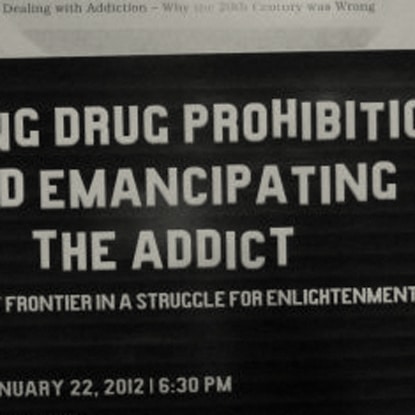
  • Talk – Ending Drug Prohibition and Emancipating the Addict: The Last Frontier in a Struggle for Enlightenment

    Talk – Ending Drug Prohibition and Emancipating the Addict: The Last Frontier in a Struggle for Enlightenment

    Time to wake up – Time to get busy – Time to step up – Make ‘em go tizzy

    Peter Ferentzy holds a Ph.D. in Social and Political Thought from York University. He’s an author and activist working hard to liberate people with addiction problems and turn over destructive drug policy paradigms. He says he knows this topic “from the gutter right up to the halls of academe”. As a historian of addiction he brings a long-term perspective. Ferentzy wrote his bookDealing with Addiction — Why the 20th Century was Wrong after he lost two friends to overdose. In both cases he says “the governing approach to addiction was the cause”.

    In his huffington post article titled “Ending Drug Prohibition and Emancipating the Addict”  Ferentzy argues that…

    emancipation of those with substance addictions is consistent with what our civilisation has been accomplishing over the last two hundred years. The overcoming of harsh attitudes toward drug addicts will be viewed in much the same light as, today, we view the abolition of harsh punishments for children, the introduction of woman’s suffrage or even the abolition of slavery.

    Catch Peter Ferentzy’s talk:

    Ending Drug Prohibition and Emancipating the Addict – the Last Frontier in a Struggle for Enlightenment

    With a special introduction by Dr. Gabor Mate. Brought to you by the PHS Community Services Public Lecture Series

  • Three drug policy stories to watch in 2012

    Three drug policy stories to watch in 2012

    Insite opens the door

    North America’s only sanctioned safe injection facility was the big news story of 2011. The September 30, 2011 Canadian supreme court decision in favor of the safe injection facility is a crucial victory for evidence-based science and policy over ideology. It is a historic decision for harm reduction advocates that has seemingly opened the door to similar services throughout Canada and possibly into the United States. It took the tenacity of the PHS Community Services Society to make it happen along with the Vancouver Area Network of Drug Users.

    The court ruling is explained on the PIVOT Legal Society’s blog “The historic Insite decision in a nutshell.” On May 17, 2011 the Director of the Canadian Drug Policy Coalition, Donald MacPherson, moderated a packed evening of discussion with legal professionals, medical experts, community activists and supervised injection site users. The evening focused on demystifying the legal battle and making the case for evidence-based drug policy.

    Check out the video here. Quebec seems like the next province set to open similar facilities.

    A recent report from the Montreal public health department has recommended opening three supervised injection sites and a mobile one in city neighbourhoods where intravenous drug use is rampant.We recently spoke with Cactus Montreal representative  Jean-Francois Mary about the impact of the ruling and future of supervised injection facillities in Montreal. You can watch the interview here.

    The Omnibus Crime Bill

    The Safe Streets and Communities Act passed in parliament with a majority vote of 157 to 127. It now sits in the senate. The conservative government has promised to push it into law by March 16, 2012, the 100th sitting day of the 41st Parliament.

    This Crime Bill moves Canada in the wrong direction. If passed, the bill will introduce mandatory minimum sentences for low-level drug crimes, further criminalizing individuals who use drugs and creating an enormous additional financial burden on society. This kind of sentencing practice has been a complete failure in the last 20 years in the United States as part of their “war on drugs.” It has deeply marginalized vulnerable citizens and done nothing to deter organized drug-related crime.

    Bill C-10 flies in the face of all of the evidence. The CDPC is not against legislation that attempts to address crime in our communities, but it must be based on a body of evidence that proves it can achieve its goals. Bill C-10 fails this test. Quebec’s justice minister has called the crime bill an inappropriate tough on democracy measure. Newfoundland’s Justice Minister has spoken out as well, saying the new crime bill will be completely unaffordable and has not been properly researched. Grand Chief Derik Nepinak of Manitoba’s Assembly of Chiefs, called a national press conference to say that the bill’s mandatory sentences would continue the legacy of residential schools, and must be opposed. Join us in 2012 as we work together withcoalition members and LeadNow and Avaaz to write next chapter.

    Canadian Medical Cannabis Regulation

    In April 2011 the Ontario Superior Court Justice Donald Taliano struck down the Marihuana Medical Access Regulations, ruling that ailing people are often unable to access medical marijuana through appropriate means and must find alternative illegal sources, risking arrest and criminal charges. He concluded that unless the government addresses the legislative flaws within three months, the criminal law would be struck down.

    The Conservative government is appealing the ruling. In June 2011 the Government of Canada announced it is considering improvements to the Marihuana Medical Access Regulations program to reduce the risk of abuse and exploitation by criminal elements.

    The proposed changes include:

    • Eliminating personal production licenses, ending legal personal home marijuana cultivation altogether
    • Eliminating patient identification cards, putting patients at risk of police action
    • Building a system of private for-profit marijuana growers and sellers who would provide to all patients in Canada,  severely limiting the range of quality strains of medicine
    • Continuing the unconstitutional “doctors as gatekeepers” system
    • Failing to address the many compassion clubs and medical marijuana dispensaries currently open across Canada

    “The government proposes to remove Health Canada as the ultimate arbiter in approving or rejecting applications to possess marijuana for medical use, and instead leave it up to doctors to decide whether their patients should be licensed to do so. While this might appear to be a liberalization, it is widely being rejected by doctors, who rightly assert that a responsibility that should pertain to Health Canada is being off-loaded on them without appropriate research having been conducted on the medicinal properties of marijuana.”

    Many members of the CDPC are calling for alternative approaches to medical and broader cannabis related policies. The Canadian Association of Medical Cannabis Dispensaries is a coalition partner working towards a regulated community-based approach to medical cannabis access and supporting medical cannabis dispensaries to provide the highest quality of patient care. Check out their campaign.

    Stop the Violence BC  is a coalition of academics, past/present members of law enforcement, and the general public concerned about the links between cannabis prohibition in BC and the growth of organized crime and related violence in the province. Calling for a regulated approach Stop the Violence makes a strong case for policy reform in BC and provides a solid foundation of public support and evidence for implementing change.

    Also in 2012-Keep an eye out for the first CDPC policy paper out soon!

    Right now, get involved in spreading the Health Officers Council of BC (HOC) recently released discussion paper, Public Health Perspectives for Regulating Psychoactive Substances – What we can do about alcohol, tobacco and other drugs.
    Together with the HOC we hope to stimulate public and governmental discussions, development of policy proposals, and action on public health oriented regulation of psychoactive substances. Subsequent to receipt of letters of support and feedback over the next few months the HOC will be submitting this paper, with necessary addenda or changes, to governments for their response and action. Send us your message of support, sign up to the coalition, and write to the HOC directly.

    Dr. Paul Hasselback, Chair
    3rd Floor, 6475 Metral Drive
    Nanaimo, BC V9T 2L9
    Fax: 250-755-3372